Welcome to your new site. This is an example page.
- This is a bullet list.
- Second entry.
Back to normal again.
- This is an ordered list.
- Second entry.
Back to normal again.
This is a blockquote.
Back to normal again.
This text is bold, in a <strong> tag.
This text is italicized, in an <em> tag.
This text is underlined, in a <u> tag.
This text has a strikethrough, in a <s> tag.
This text is subscript and superscript using <sub> and <sup>, which can be used for adding notes and citations.
This is an H1 title. It is bigger than the Page Title, which is rendered in H2.
This is an H2 header, the same size as the Page Title.
This is an H3 subheader.
This is an H4 subheader.
This is an H5 subheader.
This is an H6 subheader.
This is the "Italic Title" block style.
This is the "Subtitle" block style.
This is the "Marker" inline style.
This is the "Big" inline style. This is normal text.
This text is inside a "small" inline style. This is normal text.
This is the "Computer Code" inline style.
لكن لا بد أن أوضح لك أن كل هذه الأفكار المغلوطة حول استنكار النشوة وتمجيد الألم يعرض هذا النص من اليمين إلى اليسار.
Test
-
OBEISANCE’S TO ARTHUR
‘I left my life behind to catch a glimpse of life’ Arthur Rimbaud The road to Harar is green, along the way there are lush fields, terraced farms on slopes, high growing shrubs; the road winds upwards and it winds downwards. Children dance in its middle, they paint the white line that is not there, they own it, it is their road, they wave at the car as we weave around them. “Faranji, faranji,” they call, “you want, you want …, faranji, ten birr, ten birr …yooo, yooo yooo.” They wave branches of green leaves, they sell khat, the biggest cash crop that grows in the region, fresh, delirious. My excitement grows as we move up the slopes of the mountains, organic gold, I am going to the city of a poet, the city of an outcast who gave up poetry and turned to guns, the city of Rimbaud. -
Abej 1of 1
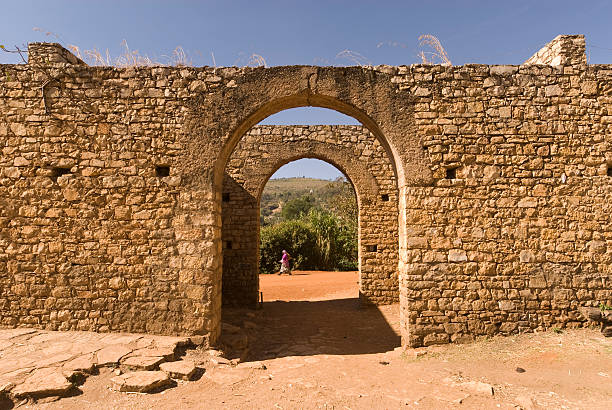
Harar Gates, Mosques and Shrines are listed.Cultural Heritage is discussed in the Material too. -
Z Herge Walagat 2of 2
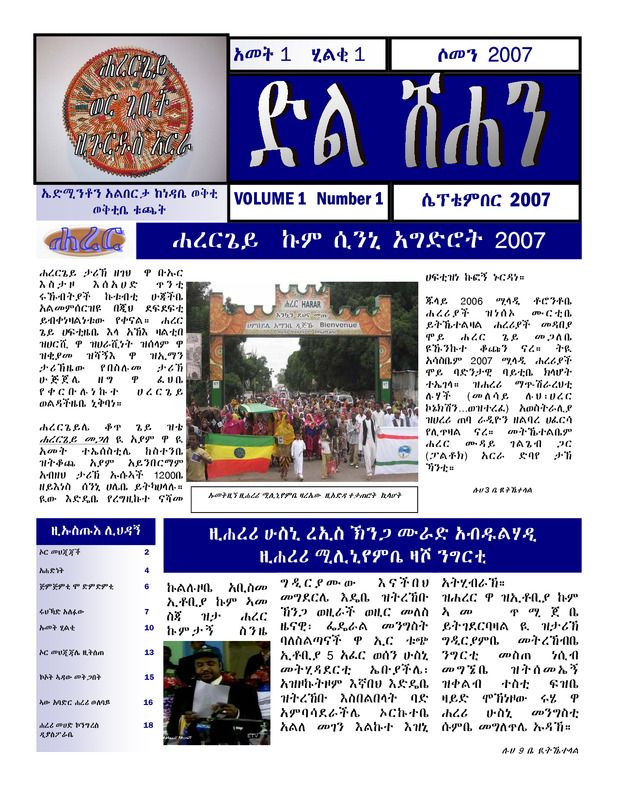
Various Harari Issues is presented in the Periodical -
Z Herge Walagat 1of 2
A print of Harari cultural and social issues. -
Z Herge Walagat 1 of 1
Various Harari social concerns discussed and cultural practices revisited. -
Z Herge Walagat 1 of 1
Various Harari social concerns discussed and cultural practices revisited. -
A Joint Statement by Community Organizations of Ethiopian Origin in Diaspora Regarding the Debate on Ethiopian Federalism
First and foremost we would like to express our appreciation and support for the process of social, economic and democratic developments which are being undertaken in Ethiopia. Henceforth, we honour and acknowledge the commitment of the Ethiopian government for its continuous effort to facilitate and consolidate the processes and advance peace, stability and security in Ethiopia regardless of internal and external obstacles aimed to discredit and paralyse the progress. The objective of this joint statement is to highlight our concern to the Ethiopian people and the Ethiopian government some of the provocative comments and statements made on the debate of “Ethiopian Federalism” on Ethiopian national TV on March 3rd 2010. On the debate, we noted that a number of representatives from opposition parties indicated that the promotion of “Federalism in Ethiopia” is inherently wrong and dysfunctional highlighting the existence of the “Harari National State” as one of the anomalies of the Federalism in Ethiopian and the Ethiopian Constitution. This joint statement provides a brief response to the restatements made on the debate and provides some of the evidences that the Harari National State is indeed a model demonstrating functional Federalism in Ethiopia and Ethiopian Constitution; and a symbol of peace, tolerance and prosperity in Ethiopia. -
Building stone of central and southern Ethiopia:
Large limestone deposits are also found in the easternpart of Ethiopia, in the Harar-Hakimgara areas. The Hakimgaralimestone has beds varying from some tens of centime -
The Mesozoic succession of Dire Dawa, Harar Province, Ethiopia
AbstractThe Mesozoic succession of Dire Dawa, Harar Province, Ethiopia, consists of a lower fluviatile sandstone (Adigrat Sandstone); an intermediate carbonate-marly unit, formerly called Antalo Limestone; and an upper fluviatile sandstone (Amba Aradam Formation). This study has shown that the intermediate unit consists of four different formations grouped into two depositional sequences. These sequences and their boundaries, Middle-Late Jurassic in age, are well correlated with sequences recognised throughout East Africa and a large part of Yemen. The base of the lower sequence (Antalo Supersequence) is time-transgressive (Pliensbachian to Oxfordian) and is the result of the first flooding of this sector of the Gondwana continent during the Mesozoic. The second major sequence boundary is also time-transgressive and corresponds to an abrupt deepening of East Africa and southern Arabia shallow water ramps and carbonate platforms, a collapse most probably related to the separation of Madagascar from Africa. A major tectonic event occurred in Early Cretaceous from northern Ethiopia to Yemen, and southern Ethiopia and Somalia. This vast uplift, testified by faults and angular uncomformities, was followed by deposition of fluviatile sediments over the entire region. -
Europe and the Mediterranean as linguistic areas: convergencies from a ...
(P 5) “On the other hand, Harari is the language of the urban population of the walled city of Harar in Eastern Ethiopia, that has been the major center of Islamic learning in the Horn of Africa for the last Five Centuries, the language is known in two historical stages: Old Harari in poetic and prosa texts written since the 16th century and modern Harari spoken today in Harar and by the Harari Diaspora in other Ethiopian cities and abroad…….” -
UNESCO’S ACTIVITIES FOR THE SAFEGUARDING OF THE
Another recent project of UNESCO in Ethiopia concerns the establishment of the Sherif Harar City Museum in Harar. UNESCO Addis Ababa was asked by the Harari People’s National Regional State to help upgrade a private museum— the Sherif Private Museum—into a public institution based on artifacts collected by Mr. Abdulahi Ali Sherif since 1991 (Tarsitani & Abdulahi, 2009). His collection includes objects related to material culture predominantly of Harari people, but also of Amhara, Argobba, Gurage, Oromo and Somali people living in the same region. The collection consists of numerous coins, jewelry, traditional furniture and utensils, basketry, textiles, armaments, as well as hundreds of manuscripts, and music recordings. Over the years, Mr. Sherif developed his own conservation methods, particularly for metal objects, benefi ting from knowledge transmitted by his father who was an ironsmith. The collection has continuously been growing, thanks to personal acquisitions by Mr. Sherif and to donations made by members of communities living in Harar. Since 1998, the residence of Mr. Sherif served as the Sherif Private Museum, and the need to upgrade this private museum had become acute since the place was so overcrowded with not enough space left for display or for properly storing the collection. Since it was a private home it was not set up to receive visitors on a regular basis. Furthermore, there was no information material for the public, and—even worse—the collection lacked a systematic inventory. In order to assist in the creation of the Sherif Harar City Museum, UNESCO— fi rst through its offi ce in Addis Ababa and later from Nairobi—managed the project with fi nancial assistance from the Government of Norway (the Harari cultural bureau and Mr. Sherif also received fi nancial assistance for the same purpose from other donors, including the Embassy of France, the Embassy of the USA, the Embassy of Sudan and private persons). The main activities of the project are described below: -
WIRSHATO: THE GOURD-SMASHING CEREMONY
ABSTRACT On Ashura, the tenth day of the Islamic month of Muharram, Hararis celebrateWirshato, a gourd-smashing ceremony that commemorates the prohibition of alcohol indicatedby the Prophet Muhammad. During the ceremony, young boys run around the city holdingsticks and singing the Wirshato song; when they enter the house compounds, they are giventraditional gourds, habitually employed to contain liquids. The boys hence smash the gourdwith their sticks and make toys out of the broken pieces, to symbolize the benefi ts that deriveby breaking bad habits. Other members of the community take part in the festivities by donatinggourds and by feasting on porridge to usher in abundance for the coming year. This briefpaper will show how the activities surrounding the Wirshato ceremony in Harar are concernedwith the concept of renewal and are derived from Islamic and customary sources.
btm
You already have access to the resource. Go back to the previous page to see it.