Welcome to your new site. This is an example page.
- This is a bullet list.
- Second entry.
Back to normal again.
- This is an ordered list.
- Second entry.
Back to normal again.
This is a blockquote.
Back to normal again.
This text is bold, in a <strong> tag.
This text is italicized, in an <em> tag.
This text is underlined, in a <u> tag.
This text has a strikethrough, in a <s> tag.
This text is subscript and superscript using <sub> and <sup>, which can be used for adding notes and citations.
This is an H1 title. It is bigger than the Page Title, which is rendered in H2.
This is an H2 header, the same size as the Page Title.
This is an H3 subheader.
This is an H4 subheader.
This is an H5 subheader.
This is an H6 subheader.
This is the "Italic Title" block style.
This is the "Subtitle" block style.
This is the "Marker" inline style.
This is the "Big" inline style. This is normal text.
This text is inside a "small" inline style. This is normal text.
This is the "Computer Code" inline style.
لكن لا بد أن أوضح لك أن كل هذه الأفكار المغلوطة حول استنكار النشوة وتمجيد الألم يعرض هذا النص من اليمين إلى اليسار.
Test
-
Special Rapporteur On Prisons...
At the 33rd Ordinary Session of the African Commission on Human and Peoples’ Rights (ACHPR) held in Niamey, Niger, the Special Rapporteur on Prisons and Conditions of Detention in Africa, (SRP) Commissioner Dr. Vera Chirwa held discussions with the government delegates from the Federal Democratic Republic of Ethiopia (FDRE) to explore the possibility of a visit to the country. At the 34th Ordinary Session of the African Commission held in Banjul, The Gambia, the FDRE made an open invitation to the Special Rapporteur to visit Ethiopia at any time. In consultation with the government of Ethiopia, a mission was scheduled for 15 – 29 March 2004. The mission falls within the mandate of the Special Rapporteur to monitor prisons and other places of detention in Member States of the African Union and make appropriate recommendations on how to enhance the rights of persons deprived of their liberty. 5. Harari Region The Harari Region is the smallest of the 11 regions in Ethiopia with a population of only 175.900 inhabitants and a land area of 374 Km². The capital of the region, Harar is one of the most popular historical towns in the Eastern part of Ethiopia. The State has no administrative zones or Woredas. It has about 19 Kebeles. The Region has located in the Eastern part of Ethiopia, surrounded by the Oromia Region. The ethnic composition includes Oromo 52.3%, Amhara 32.6%, Harari 7.1%, and Guragies 3.2%. Harari language is the official language of the State. The religious composition of the population indicates that 60.3% are Muslims, 38.2% Orthodox Christian, 0.9% Protestants, 0.55 Catholics, and 0.1% followers of other religious groups. The region has only one prison with an inmate capacity of 1000 but holds about 1370 prisoners – 1296 male and 74 female. It must be noted here that more than half of the inmates in this prison are from the Oromia Region detained in the Harar prison because the Oromia regional government does not have enough prisons to keep them in. While in the Harar prison, the Oromia regional government provides money for their daily upkeep and transportation to court for those whose cases have not been disposed. The prison has a small clinic with no resident doctor but has three nurses – 2 assistant nurses and a sanitation officer. The male section is separated from the female section. A juvenile cell of 4m x 7m with 12 inmates is not completely separated from the adult section as there is free movement of adults in and out of the juvenile block. The prison had 31 cells of different sizes – some 4m x 5m with 10 inmates, some 6m x 7m for 29 inmates, some 5m x 7m for 14 inmates and others 6m x 15m for 55 inmates. The 84 female prisoners are living in only 4 cells some of them with very rough and dirty walls. The walls, as well as the floors are not cemented. The area is very small and has no space for recreational and other activities. The prison has a volleyball court and offers vocational training – woodwork, metal work, and brick laying only to male inmates. The authorities plan to introduce sewing for female inmates. There is a school that offers classes up to grade 6. The school is accredited by the regional ministry of national education. There is an acute shortage of water in the prison. This is as a result of water shortage in the region as a whole. -
Harar, Ethiopia. Dualities, discursive meanings and designations
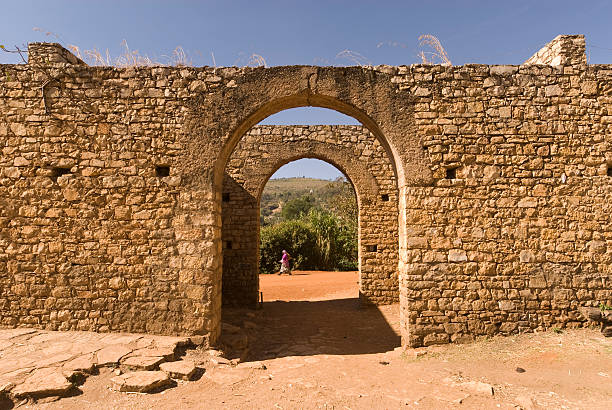
Published in English with Italian summary in Urbanistica pvs (La Sapienza, Univ of Rome), 54/55: 28-37, 2010Harar is a city of 120,000 inhabitants situated on a plateau in an agricultural region of eastern Ethiopia. The city is divided into new and old districts and is separated - spatially and symbolically - by high walls punctuated by six gates through which foot and vehicular traffic pass. Oral tradition has it that the old city, Harar Jugol, dates to the 10th century, whiles the new city, named New Town in this article, dates to the latter 19th century. Perhaps related to this newness, scant attention has been accorded to New Town’s built form in contrast to Jugol, the city located within the fortifications. In this article divided into three parts, a critical ethnographic lens is employed to problematize characteristics of Harar’s spatial and social terrain. Low’s (1996) theoretical framework for contemplating and analyzing cities is used to explore numerous dualities, boundaries and tensions that exist in Harar’s current urban environment, with focus placed upon New Town. This paper conceptualizes Harar as a discursive realm, where signs and symbols written on the city’s landscape and in the daily practices of citizens point to linkages to broader social processes, politics, policy, and ideology. The analysis concludes by critically exploring three challenges that currently face the city of Harar with respect to urban planning and land use that are challenging to reconcile because of dissimilar understandings of the city, competing roles in urban governance, and the unavailability of a sufficient local water source. -
Battle of Cheleqo
The Battle of Chelenqo was an engagement fought on 6 January 1887 between the army of Shewa under Negus Menelik II and Emir 'Abd Allah II of Harar. The Harari forces were routed, and Negus Menelik afterwards occupied and annexed the city of Harar. Negus Menelik, in response to Italian control of parts of Eritrea and the port of Massawa, had begun to import firearms and munitions through the French-controlled ports of Djibouti. By 1886, Emir 'Abd Allah of Harar had blocked transport of these arms through his territories. Menelik had desired control of the city of Harar for some time. The massacre of the Italian explorer Count Pietro Porro and his entire party in April 1886, allegedly at the emir's command, gave the Negus an excuse to march on Harar.[1] Although the army of Shewa was a veteran force with contemporary rifles, and numbered in the thousands, Negus Menelik sought to avoid war, and in January 1887, offered 'Abd Allah the same kind of autonomy that king Abba Jifar of Jimma enjoyed; the emir refused this offer. Knowing that he was heavily outnumbered, and his troops had only obsolete matchlocks and a few cannons, Emir 'Abd Allah decided to attack on early in the morning of Ethiopian Christmas (January 9), expecting the Shewans to be unprepared and befuddled with food and alcohol. However, Negus Menelik had worried about a surprise attack, and kept his men at alert. The emir's men opened fire at 11:00 am. The Shewan soldiers quickly responded and routed the Harar infantry with few casualties. Menelik pursued the retreating emir to Harar, whose ancient walls would not long resist his assault. Once again 'Abd Allah refused to surrender, then fled into the desert, leaving his uncle to negotiate the city's surrender. With the occupation, the independence of Harar came to an end. -
Harar Water Supply & Sanitation Project
DescriptionThe project will consist of the following components: 1. The project consists of the following main components: 2Water Production: This will consist of the following outputs: Four additional boreholes in the Dire Jara wellfield, a 75 km long, 600 mm diameter ductile iron transmission pipeline, and introduction of an aquifer monitoring system. The Dire Jara wellfield consists of 12 new boreholes which have already been developed with a capacity of 200 l/s. The additional boreholes with a capacity of 68 l/s will be constructed at the wellfield increasing production capacity to 268 l/s. All the boreholes will be connected to a 2000 m3 Collector Reservoir from which the transmission pipeline will transfer the water to Harar and the other towns raising it about 840 m via 4 booster pumping stations to a 4000 m3 reservoir at the highest point in Dengego. Pump houses, staff houses and administrative buildings and access roads will also be constructed at the wellfield and the booster stations. A pipeline from the wellfield to Dire Jara will serve the villagers with one of the boreholes. Equipment and chemicals for groundwater monitoring will also be provided. 3Water Distribution: The main outputs of the component are the rehabilitation and extension of 115 km of distribution network with a number of service reservoirs and break pressure tanks, 47 public fountains, and provision of 4000 consumer meters and a meter test bench. The activities include the replacement of the distribution network in Jegol, and its extension to other parts of Harar, Alemaya and Awudai. Service reservoirs or break pressure tanks will be provided in each distribution zone. In addition 47 community managed public fountains will be constructed for low-income consumers and 4000 consumer meters provided for new house connections. A meter test bench and meter repair kits as well as plant and equipment and spare parts for operation and maintenance will be provided. 4Sanitation: This component will have the following outputs: 3 public latrines and 35 community managed communal latrines, 2 large and 1 small vacuum tanker, 2 refuse collection vehicles, and 35 refuse bins (transfer containers), 12.2 km of drainage system, and sanitation study report. The 3 public latrines and 35 community managed communal latrines will be constructed in different parts of Harar, Alemaya, Awudai, Adele and Dengego in locations identified by the communities. A drainage system consisting of 2.2 km of open channels and 10 km of closed conduits will be constructed in Harar. The 2 large and 1 small vacuum tanker will be provided for emptying septic tanks and soakaways and pit latrines in the towns. The small tanker will serve the narrow streets of Jegol while the large tankers will serve the rest of the towns. In addition, a sullage system is being implemented in Jegol with funding from the ESRDF, which will serve to evacuate the increased quantities of water flowing into Harar. The 35 refuse transfer containers and 2 refuse collection vehicles will serve to improve the solid waste management system. 5The project will also fund a sanitation study which will determine the feasibility of converting the sullage system into a small-bore shallow sewerage system for Jegol and the rest of Harar as well as address the sanitation problems for the medium and long-term. The study will also determine feasible options for an improved solid waste management system, which will include the development of a proper dumpsite as well as look into the feasibility of community waste recycling as a means of livelihood. 6Public Education: The outputs of the component are increased awareness of water and health relations, HIV/AIDS and acceptance of the tariff increases. The activities include the use of the media, seminars, workshops, development and wide dissemination of publicity materials, etc, to raise awareness about water quality and health, water related diseases, HIV AIDS, and the need to raise tariffs in the town to meet the high cost of the proposed water supply system. It will be conducted by the Information and Health Bureaus of the Harari Regional Government. 7Institutional Support to HTWSSSA: The outputs are a better managed utility operating on commercial lines, with improved customer database, regular monthly billing, improved revenue collection to 90% of billing, and reduction of unaccounted for water to 18%. HTWSSSA will be provided with technical assistance in the areas of utility management, operation and maintenance, commercial and financial management. The civil works contractor and supervision consultant will provide the required operation and maintenance manuals and training in their use and operation and maintenance management in general. In addition experts will be recruited from a firm of water utility operators to assist HTWSSSA to put in place the proposed institutional structure, recruitment of the required additional staff, development of manuals for and training of the staff in various aspects of utility management, commercial and financial management and in the use of appropriate computer software and hardware. --------------------------------------------------------------------------------ObjectivesTo improve access to water supply and sanitation services in Harar, Alemaya, Awudai, Adele and Dengego through improved water production, distribution and sanitation for improved health, poverty alleviation and economic growth. --------------------------------------------------------------------------------BenefitsThe project will restore water supply to meet domestic and industrial demand in Harar, Alemaya and Awudai to the year 2024 and improve the sanitation situation in the towns. This will reduce the incidence of water related diseases and the proportion of the health budget and family income used to treat such diseases as well as the time lost due to illness from such diseases. The time spent by women and children collecting water will reduce as well as school absenteism by girls. The project will make it possible for a number of industries to be established in Harar, which are presently prevented from doing so by the lack of water. This will create jobs and improve the economic situation in the area. --------------------------------------------------------------------------------Key contactsALEOBUA Boniface Osimua Yakubu - OWAS2 --------------------------------------------------------------------------------CostsFinance source Amount ADF UAC 21,010,000 Co-financier UAC 6,100,000 Delta UAC 1,880,000 Total UAC 28,990,000 SubscribeRSS feedsEmail alertsKey documentsNEPADProject Appraisal ReportsProject/Programme Completion ReportsLoan and Grant ConditionsProjects Performance Evaluation ReportCompletion Reports ReviewProjects EvaluationLending RatesRisk ManagementProcurement NoticesIntegrity & Anti-Corruption ReportsEnvironmental & Social AssessmentsUseful LinksIndependent Review MechanismIntegrity and Anti-Corruption -
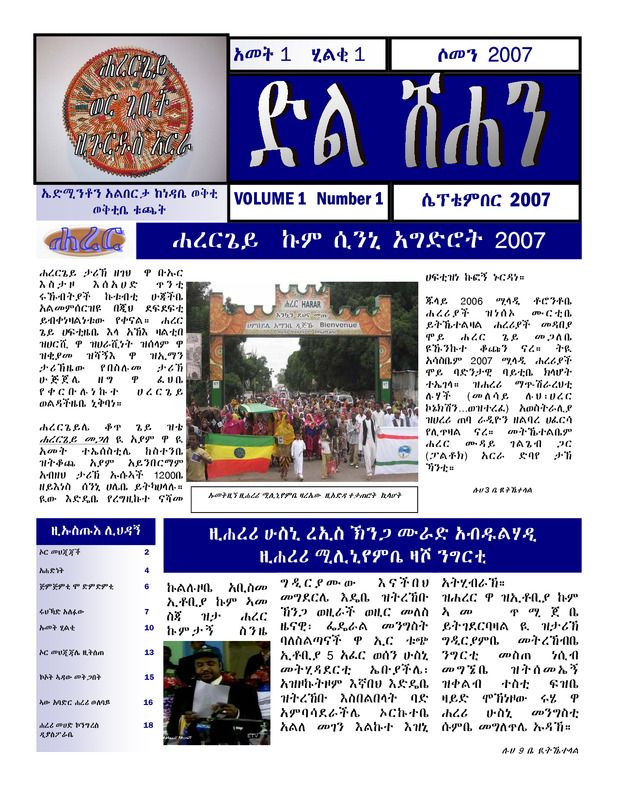
Harari Children
The publiction looks into the Harari Identity based on discussions made among Hararis on the Harari Net. -
A leap of faith
arly Muslims looked beseechingly to Ethiopia and sought refuge in its territory from their persecutors, the polytheist Arabians. But the Christian kingdom, besieged for 15 centuries by Islamic states that formed a formidable ring around it, refused to succumb to the new religion. Gamal Nkrumah explores the often contentious connection between Ethiopia and Islam -------------------------------------------------------------------------------- Since time immemorial Ethiopia has retained her supercilious air. Throughout the centuries, the rugged Nile Basin country, bound to Islam from the religion's inception, has attracted scant attention compared to Egypt. Ethiopia's seclusion, however, did nothing to dispel its mystique. Ethiopia's ambiguous identity fascinated those outsiders who cared to take a closer look. Black, but not black enough. Christian, but only partially so. At once both primitive and civilised. Numerous Arab and Muslim chroniclers have lavished praise on the only land beyond Arabia's borders that Prophet Mohamed turned to in his hour of need -- the only country that responded positively to his call for assistance. Perhaps the most important Arab treatise celebrating the special role Ethiopia played in early Islam was Jalal Al-Din Al-Suyuti's seminal work Raf^ Shan Al- Hubshan (The Raising of the Status of the Ethiopians), written in the late 15th century. It was an earnest plea to reaffirm the equality of the races in Islam. Ahmed Bin Ali Al-Maqrizi, who in 1435-36 wrote Kitab Al-Ilmam bi Akhbar man bi-Al- Habasha min Muluk Al-Islam (The Book of True Knowledge of the History of the Muslim Kings of Abyssinia), focussed on the mediaeval Muslim sultanates in the Horn of Africa, including those within the country today known as Ethiopia. -
Aner2
-
First Foot Steps in East Africa
-
Afocha: A Link between Community and Administration In Harar Ethiopia
Rural Sociology; Winter81, Vol. 46 Issue 4, p754-756, 3p Document Type: Book Review Subject Terms: BOOKS -- ReviewsCOMMUNITY organizationNONFICTION<p -
Ethiopia, the Uknown Land: A Cultural and Historical Guide
-
Ethiopia
-
The Conquest of Abyssinia
A translation of the Arabic book of Fathul Habash into English.Translated by Paul Lester StenhouseAnnotations with Richard PankhurstPreview not available.Availble to purchase from Malsay web site.
btm
You already have access to the resource. Go back to the previous page to see it.