Welcome to your new site. This is an example page.
- This is a bullet list.
- Second entry.
Back to normal again.
- This is an ordered list.
- Second entry.
Back to normal again.
This is a blockquote.
Back to normal again.
This text is bold, in a <strong> tag.
This text is italicized, in an <em> tag.
This text is underlined, in a <u> tag.
This text has a strikethrough, in a <s> tag.
This text is subscript and superscript using <sub> and <sup>, which can be used for adding notes and citations.
This is an H1 title. It is bigger than the Page Title, which is rendered in H2.
This is an H2 header, the same size as the Page Title.
This is an H3 subheader.
This is an H4 subheader.
This is an H5 subheader.
This is an H6 subheader.
This is the "Italic Title" block style.
This is the "Subtitle" block style.
This is the "Marker" inline style.
This is the "Big" inline style. This is normal text.
This text is inside a "small" inline style. This is normal text.
This is the "Computer Code" inline style.
لكن لا بد أن أوضح لك أن كل هذه الأفكار المغلوطة حول استنكار النشوة وتمجيد الألم يعرض هذا النص من اليمين إلى اليسار.
Test
-
Fath ul Rahman
-
Reviewed Work(s): Afocha: A Link between Community and Administration in Harar, Ethiopia by Peter Koehn and Sidney R. Waldron-Maxwell
Northeast African Studies, 4, 1 (1982): 65-67 REVIEW OF Peter Koehn and Sidney R. Waldron-Maxwell , Afooha : A Link between Community and Administration in Harar 3 Ethiopia. Syracuse, New York: School of Citizenship and Public Affairs, Syracuse University. Pp. 120, 6 maps. Mohamed Hassen School of Oriental and African Studies University of London Harar, the present provincial capital of Hararghe administrative region, used to be a unique center in North East Africa. Before the Addis Abeba- Djibouti railway road by-passed the city and made the old caravan route obsolete at the beginning of this century (thus undermining the mercantile economy of the city), Harar was a major commercial entrepot whose fame spread far and wide and led to prosperity for its citizens. Located 175 miles southwest of the port of Zeila and 219 miles from the port of Berbera, Harar was the center at which a number of major and minor caravan routes met. Along the caravan routes that linked ports of the northern Somali coast with Southern Ethiopia there were a number of commercial centers (settlements). Today there are no less than twenty-one ruined commercial settlements between Zeila and Harar. Some still dot the Ogaden region, while others are found in the region between Harar and Bale. -
AFOČA
-
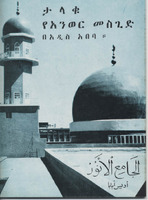
Anwar Masjeed
-
Ethnomedicinal plants used to treat human ailments in the prehistoric place of Harla and Dengego valleys, eastern Ethiopia
Traditional medicines remained as the most affordable and easily accessible source of treatment inthe primary health care system among diverse communities in Ethiopia. The Oromo community living in theprehistoric Harla and Dengego valleys has long history of ethnomedicinal know-how and practice against humanand livestock ailments. However, this rich ethnomedicinal knowledge had been remained unexplored hitherto.This study focus on the comprehensive ethnomedicinal investigation in an attempt to safeguard the deterioratingethnomedicinal knowledge that can be used as a steppingstone for phytochemical and pharmacological analysis. -
Assessment of Traditional Medicine Utilization in Harar Town, Eastern Ethiopia
Traditional medicine (TM) has been part of man’s survival for long time. Harar is an ancient trade route and has a close proximity to the red sea. The use of TM is common and the majority of its habitants use TM. This study was conducted to assess why Harar households continued to prefer and depend on the utilization of TM as part of their healthcare system. Community based cross sectional study was conducted to select head of 423 households. Data was collected using face to face interview with a semi structured questionnaires and descriptive statistics including mean, standard deviations, frequencies and percentages were performed to examine the outcomes and associated factors. The result shown that 60.50% of the households preferred to use TM as their primary health care services and used TM for curative of ailments because TM had minimal side effects compared to modern medications. Socio demographic factors had no significant association to TM use; however, other associated factors had strong association with TM use. Personal experience such as minimal side effect of TM, attitudes towards TM use such as cost effectiveness, effective for specific diseases and quality service such as ready availability of TM had strong association to TM utilization. It was concluded that TM is still continued to play a significant role in healthcare of many households of Harar town because TM is dependable, affordable, safe and cost effective. -
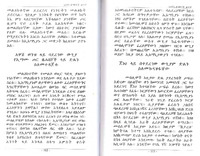
FUTUL Al Habash ...V2-2 (Amharic)
-
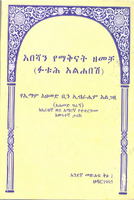
FUTUL Al Habash ...V2-1 (Amharic)
-
Malasay
From Google Translator The Mäläsay must, at least according to the testimony of modern historians, have a have been a capable group. J. Doresse (1971: 205) counts the troops of the Gran and calls them: les Malasay, musulmans convertis de tout leur coeur à la défense de leur foi et conduits par l'Imam (Gran). A little later (Doresse 1971: 209) they stand next to one another irregular religious fighters (gazú) as "absolument des soldat musulmans – les Malasay" Around 1570 AD. it is then "chefs des malasay, troupes régulières musulmanes, fidèles à l'Ethiopia, "which the Emir of Harar has destroyed and with it an offensive on the part Särsä-Dengels (Doresse 1971: 231). R. Ferry (1962: 30) describes the mäläsay as one of the peoples in Gran's army, which of course is difficult to match with today's ethnic groups. to conclude: "gens analogues aux Somalis, mais plus intéressés à la guerre sainte." These Interpretations of the term mäläsay refer to its use in Arabic history about the first conquests of the Gran of 'Abdal-Qadir' Arabfaqih and its mention in two Ethiopian chronicles – in the so-called "Short Chronicle" and the Chronicle of the Särsä-Dengel – back. R. Basset (1897: 84 n.4) in his French adaptation of 'Arabfaqih tried an etymological interpretation. Starting from an Amharic Verb mälläsä with the special meaning "convert" or a Tigrinya verb mäläsä "to- return "one could perhaps explain the name; he suspects that it is "Converts," notes that the common word in Ge'ez for Muslims is tänbälat (cf. Dillmann, 1865: 562) is and refers to Portugal cited by Pereira (1887: 799 η. 17) Giesian reports from the 16th century, where this name is freely associated with the Amalekites is adorned. In his adaptation of the "Short Chronicle", in which the word mäläsay also appears in the report on the Gran Wars. , Basset (1883) abstained from any comment. F. Béguinot (1901: 18 η. 6) adopts Basset's conjecture in his Italian revision of the “Short Chronicle "and adds the note that the mäläsay…. -
THE MEDIEVAL MOSQUES OF NORA ISLAMIC ARCHITECTURE IN ETHIOPIA*
In April-May of 2008, a team led by François-Xavier Fauvelle and Bertrand Hirsch carried out excavations on the Muslim site of Nora (Fauvelle and Hirsch, 2008: 339-376). The author of the article was in charge of the excavation of the great mosque and the study of the others mosques on the site. Apart from Aksum, Nora was the first town ever excavated extensively in Ethiopia. Located 20km to the north-east of the current town of Shewa Robit (in the Shewa Region) near to the village of Wässiso, the Nora site is located midway between the high plateau and the flood plain of the River Awash at an depth of approximately 1300m (Fig. 1). The site was discovered in January 2007 during some surveys to recognize the evidence of hitherto medieval settlements only known in primary sources (Fauvelle and Hirsch, 2011). It was a ruined town which extended over several hectares (Fig. 2). The elevation of many of the walls, particularly those of the Great Mosque, has been preserved. The town also provides evidence of street networks and access routes, town walls, necropolis compounds and possibly hydraulic facilities…… -
Scribal Practices in Arabic Manuscripts from Ethiopia: The ʿAjamization of Scribal Practices in Fuṣḥā and ʿAjamī Manuscripts from Hara
This paper focuses on Arabic scribal practices in a corpus of Ethiopian Islamic manuscripts from the region of Harar ascribed to the period from the eighteenth to the early nineteenth century. Two different aspects will be considered, namely the characteristic realization of specific graphemes and the methods for the justification of the text. The observations take into account the perceived sacred dimension of the texts, from copies of the Qurʾān to ʿAjamī works, and the different level of standardization of their written manifestations. This approach is intended to highlight the results of the cultural interplay between the scribal models acquired and their local reinterpretation in order to identify reference models and determine the criteria at the base of the processes of ʿAjamization of these scribal practices. I hope that the characteristics described in this article will represent the starting point for comparative studies of scribal practices between different Ethiopian regions and with other regions of the Islamic world.... -
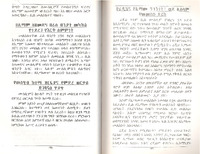
FUTUL Al Habash ...V1-2 (Amharic)
btm
You already have access to the resource. Go back to the previous page to see it.