Welcome to your new site. This is an example page.
- This is a bullet list.
- Second entry.
Back to normal again.
- This is an ordered list.
- Second entry.
Back to normal again.
This is a blockquote.
Back to normal again.
This text is bold, in a <strong> tag.
This text is italicized, in an <em> tag.
This text is underlined, in a <u> tag.
This text has a strikethrough, in a <s> tag.
This text is subscript and superscript using <sub> and <sup>, which can be used for adding notes and citations.
This is an H1 title. It is bigger than the Page Title, which is rendered in H2.
This is an H2 header, the same size as the Page Title.
This is an H3 subheader.
This is an H4 subheader.
This is an H5 subheader.
This is an H6 subheader.
This is the "Italic Title" block style.
This is the "Subtitle" block style.
This is the "Marker" inline style.
This is the "Big" inline style. This is normal text.
This text is inside a "small" inline style. This is normal text.
This is the "Computer Code" inline style.
لكن لا بد أن أوضح لك أن كل هذه الأفكار المغلوطة حول استنكار النشوة وتمجيد الألم يعرض هذا النص من اليمين إلى اليسار.
Test
-
Sixteen Letters Of Ras Mekonnen and His Sons to Hajj Ahmad Abonn of Harar
A Letter from one of the Harari Public ServantsTo the Governor Of Harar In early 1900 -
Somal and Gala Land
In Northern Somal Land, Lieut. Cruttenden is entitled to the credit of having first penetrated into the interior of the country,for Mr. R. Stuart,whom Salt despatched to Zeyla with instructiont so proceed to Harar, rt ever left the coast; whilst Lieut. Barker, who endeavoured to reach that point from Shoa in 1842, failed in his e:aterprise. Mr. Cruttenden looked down from the sutnmit of the Airansidu pon the broad vale of the Tok :Daroro, r "river of mist " (1848). Captain Speke e:xtended these explorationss is years afterwards;a nd CaptainB urton, in 185S,achieved one of those triumphs which it is given to few travellers to achieve. :He reached Harar, the old capital of Adea, the first European xvho did so, although that town lies within a few marches from the coast, and was known by report to the old Portuguese. -
A journey through Abyssinia to the Nile
-
Three Arabic Documents On The History of Harar
-
Khat in the Horn Africa : Historical perspective and current trends
-
The Extended East Route, Ethiopia, Somaliland, Djibouti. A pictorial guide
The Extended East Route, Ethiopia, Somaliland, Djibouti. A pictorial guide A vital alternative to the Great North or classic tourism Route in Ethiopia, this new route is a 3000 km long cultural, naturalistic way spanning three countries. It offers four variants and a main track setting from Addis Ababa, Djibouti or Berbera/Hargeisa ,touching circularly five regional states in Ethiopia, Somaliland and Djibouti. THE EXTENDED EAST ROUTE for cultural and naturalistic tourism It was independently developed by prof. Marco Vigano’in2007-2010 as he proceeded to investigate with voluntary teams of friends, students and experts in fields as varied as geology, Speleology or cave science, archaeology, natural science, sociology and anthropology, a set of discoveries in the Ethiopian East. -
The Great Ethiopian Famine
Clemente da Terzorio, describing the situation at Harar, writes for example of large numbers of flies which after sucking the putrifying matter of corpses then landed on the living.178 The eating of decaying and other impure food may also be presumed to have had effects very detrimental to health. The result was that smallpox, typhus, cholera, and dysentery made their appearance in many parts of the country and carried off large numbers of people.179 Wurtz relates that the incidence of smallpox in particular was greater than ever before, and adds: "people died in masses; -
Annual Report
Climate Change awareness raising workshops were conducted in two branches (Wolaita and Harar) for school teachers. The workshops conducted in the last quarter of 2008, gave them a basic understanding of climate change, its causes and effects, and appropriate ways to reduce the impact of disasters resulting from climate change. In total, 200 teachers took part in the awareness raising workshops, most of who were already involved in the Red Cross movement through running HIV and AIDS or environmental protection clubs in their schools. • In order to enhance the ERCS’s ability to respond to emergencies, contingency stocks were built up in several locations across the country. Three branches were selected for prepositioning of non-food relief items – Harar for Eastern Ethiopia, Addis Zemen for Northern Ethiopia and Wolaita branch for the south. It was not possible to conduct a warehouse survey before selecting these locations, but in the west a warehouse survey was carried out in several branches at the end of December 2008. -
World War, SOUTHERN THEATRE: Key Towns
Wherever three or four women squat beside piles of grain and peppers, there is Harar's market place. Before the town's Law Courts there is a constant babel of dissatisfied litigants. In five minutes on any street one may see an Armenian fighting with a Hindu; an Abyssinian woman with her simian face smeared with rancid butter to keep vermin away; an old bishop who knew the strange, sad, lame poet-adventurer Rimbaud, France's Byron, when he lived in Harar; a beautiful, brown-skinned, high-breasted Harari woman carrying a load of wood on her head as if it were a tiara ; a big black with a lion cub on a leash; an Abyssinian policeman who looks ferocious with leaves stuffed in his nostrils (he just has a cold) ; a leper from the Capuchin colony outside the walls; a crisp Italian officer in a fever of hurry and worry. In a special fever last week were the Italian soldiers stationed in Harar. For the city had become the next British objective. Early last week the South African and British column pushing up from Italian Somaliland approached Giggiga, 50 miles east of Harar. Its supply lines were then about 600 miles long, and were potentially threatened from the east by Italians garrisoning British Somaliland, which the Italians occupied last summer. The threat was removed at the strategic moment by a British naval force which appeared off Berbera, British Somaliland's capital and main port, one midnight, and landed men and machines in two places near the town. By 9:30 a.m. they had taken it. They pushed inland at once, and by week's end had very nearly made contact with the inland column. -
World War, SOUTHERN THEATRE: Last Act in East Africa
Harar fell the same day as Cheren to a British column advancing from Somaliland in the south. Italian resistance in Marda Pass before Harar was surprisingly light, and the British met almost no resistance at Harar itself. This column's mission—breaking the Addis Ababa-Djibouti railroad—was accomplished at week's end when the British announced they had occupied Dire Dawa, the nearest station to Harar on the railway, and that the Italians had withdrawn westward toward the capital. Main reason given by the Italians for this withdrawal was again British air activity. All week long and all along the railroad, the British bombed trains, supply depots, bridges, tracks. With their communications cut behind them, the Italians at Harar were forced to retire -
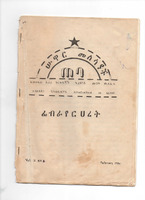
Sawar Malasayach V3.No.3
Sawar Malasyach is a magazine written by Hararies Living in Exile, in Egypt. The paper addresses the Harari struggle against oppression. -
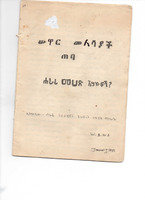
Sawar Malasayach- Revolutionaries V3 .No.2
Sawar Malasaych was an editorial journal written in 1980 by Hararies living in Cairo, Egypt in exile. The papers addresses the Harari movement conditions and destiny.
btm
You already have access to the resource. Go back to the previous page to see it.