Welcome to your new site. This is an example page.
- This is a bullet list.
- Second entry.
Back to normal again.
- This is an ordered list.
- Second entry.
Back to normal again.
This is a blockquote.
Back to normal again.
This text is bold, in a <strong> tag.
This text is italicized, in an <em> tag.
This text is underlined, in a <u> tag.
This text has a strikethrough, in a <s> tag.
This text is subscript and superscript using <sub> and <sup>, which can be used for adding notes and citations.
This is an H1 title. It is bigger than the Page Title, which is rendered in H2.
This is an H2 header, the same size as the Page Title.
This is an H3 subheader.
This is an H4 subheader.
This is an H5 subheader.
This is an H6 subheader.
This is the "Italic Title" block style.
This is the "Subtitle" block style.
This is the "Marker" inline style.
This is the "Big" inline style. This is normal text.
This text is inside a "small" inline style. This is normal text.
This is the "Computer Code" inline style.
لكن لا بد أن أوضح لك أن كل هذه الأفكار المغلوطة حول استنكار النشوة وتمجيد الألم يعرض هذا النص من اليمين إلى اليسار.
Test
-
AGRI- AGRI AND BERTI-BERTI: CONVENTIONAL MILITARY TRAINING IN THE EMIRATE OF HARAR
The objective of this paper is to discuss the factors that contributed most to the survival of Harar as an independent principality. -
The Insect Pests of Vegetables In Harar Province
The cultivation of vegetables in Harar Province is carried out mostly in small mixed lots by native fanners. -
HYENA PORRIOGE; ETHNOGRAPHIC FILMING IN THE CITY OF HARAR
Harar and the Hyena man become synonymous in the minds of many people. Every tourist who has been to this ancient walled city knows about the man who feeds the hyena. -
A Topographic Survey and Some Soundings at Nora, an Ancient Muslim
Introductory BackgroundThe GendebelolNora Program (French Center for Ethiopian Studies, Addis Ababa;Agence Nationale de la Recherche; Centre National de la Recherche Scientifique) isconducting a survey of medieval Muslim sites located in Yifat, north-eastern Shewa,Ethiopia (Fauvelle-Aymar et al. 2007). These sites are but little known from theliterature (Traversi 1893; Chernet Tilahun 1990; Kebedde Geleta 2000). TheGendebelolNora III mission, whose results are briefly presented here, was conductedon the site of Nora between the ith and the 19th of October 2007. The objective ofthis mission was to start the topographic mapping of the visible remains, to carry outtest pits in order to obtain information about the stratigraphic potential of the site forpossible future excavations, and to propose a tentative sequence of occupation.Nora (N 09°50'849'" E 40°03'026''') is a Muslim medieval town which, due to itssimilar architecture with other Muslim ruins found in the Tchertcher massif and basedon radiocarbon testing (1293-1399 cal. AD - LY-10197, and 1407-1444 cal. AD -LY-10196) obtained on the similar mosque of Faqi Dabbis in Yifat (Hirsch &Fauvelle-Aymar 2002: 330-331; Poissonnier 2005), can be considered to have beenbuilt between the 13th and the 16th centuries AD. This town occupies a rocky spur atan altitude of 1300 m above sea level (Fig. 1). The site is naturally well protected,being surrounded by abrupt cliffs on almost all sides. On the south-west, the sinuoustrack from the nearby Argobba village of Wosisso comes out, and on the north, aridge path leads to other ruins. -
HARAR AND LAMU - A COMPARISON OF TWO EAST AFRICAN MUSLIM SOCIETIES
Having been in both cities, Harar as well as Lamu, it is fascinating to compare I the two communities and societies with each other. There are several phenomena both share with each other. To begin with, both are Muslim urban societies in East Africa - Harar in Eastern Ethiopia, Lamu on Lamu Island at the Northern Coast of Kenya. Both their economies had at one time and for long periods largely depended on international and intercontinental trade, and both are remnants of civilizations which at one time had spread over wider geographical areas than they do now. Both are however, even today, intact examples of preindustrial urban societies. -
Harari Basketry through the Eyes of Amina Ismael Sherif
Harer is located in East-Central Ethiopia. The old walled city, known as Jugal, has a population of over 30,000. Jugal is pear-shaped and covers an area of 48 hectares. It is the home of the indigenous Harari as well as other peoples - Oromo, Somali, and Argobba. Indeed, people from virtually all parts of Ethiopia may be found in this great walled city.Much has been written about the natural beauty of Harer. More than forty years ago John Buchholzer commented: "It doesn't matter whether you go there when the coffee bushes are in flower and the air is heavy with their strong, bitter scent, or when the ripe fruit of the orange trees glow in the sunlight, it is always lovely in Harer; there is always something blooming, always something being harvested" (1955: 101). A mountaintop view of Harer reveals a mosaic of diverse scenery (fig. 3.2). One sees great natural beauty complemented by the beauty of the human-built environment. The colors are remarkable. Outside the city walls the lush green foliage and meandering streams remind one of Persian carpets. In contrast, inside the old walls the colors and shapes change; one sees primarily whites and grays and a diverse range of geometric shapes of varying size (figs. 3.3-3.4). The hill on which the old city rests is a constantly changing organic form, shaped and reshaped by the hands of masons for over a millennium. The houses, mosques, churches, marketplaces, and narrow streets form this magnificent work of art.Moving from a macro- to a micro view of the city reveals an abundance of aesthetic traditions that echo this beauty. The Harari house is warm and inviting and displays a sense of proportion and a mastery of a building technology perfected over the centuries. Inside the house, one is overwhelmed with the balance and color composition of the traditional display of baskets on the walls of the living room (fig. 3.5). The colorful dress of Harari women is another dimension of the beautiful aesthetic that permeates Harari life. -
PALAEONTOLOGY OF HARRAR PROVINCE, ETHIOPIA
pt. 1. The Dudley Expedition / by Barnum Brown. The Harrar Plateau. Crystalline basement. The Adigrat sandstone. Upper Jurassic limestones. Cretaceous deposits. Nubian sandstone(?). Tertiary and Quaternary deposits. The Dirre Daua region. The Hargeisa, British Somaliland, region -- pt. 2. Echinoidea / by Ethel D. Currie. Jurassic Echinoidea from Ethiopia. Cretaceous Echinoidea from Ethiopia. Eocene Echinoidea from British Somaliland. -
Antibiotic susceptibility patterns of Salmonella and
The study was conducted in two of the four referral hospitalslocated in Harar, eastern Ethiopia. A convenience sample ofpatients who visited the adult outpatient departments of Hiwot Fanaand Misrak Arbegnoch teaching hospitals from January 2007 toFebruary 2007 for complaints of diarrheal disease was included inthe study. These hospitals were selected for the study because oftheir close affiliation to the Faculty of Health Sciences of HaramayaUniversity where the laboratory used for this study is located. Thepatient flow of the hospitals ranges from rural and urban dwellers toclients of diverse socioeconomic and ethnic backgrounds. -
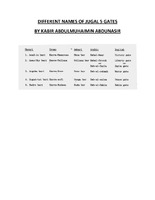
Different Names of Jugol 5 gates
Abdulmuhaimin gives corresponding names for the Harar jugol gates in 4 different languages, Amharic, Oromo, Somali, and English, -
BELEAGUERED MUSLIM FORTRESSES AND
J.S. Trimingham has famously described Ethiopia as a “beleaguered fortress in the midst of a sea of Islam,” implying Christians in Ethiopia have consistently been besieged by Muslims, not vice versa. This thesis challenges this common conception by demonstrating that throughout Ethiopia’s medieval period (1270-1555), the time of greatest conflict between the Ethiopian Empire and its Muslim neighbors, Muslim forces did not besiege the Ethiopian Empire. On the contrary, the Ethiopians militarily subjugated their neighboring Muslim sultanates, most prominently Ifat and Adal, and politically divided the sultanates’ ruling families to keep them weak. These tactics, designed to wrest control of trade from the sultanates, were resoundingly successful until Muslims unified around military/religious leaders, primary among them being Imam Gran, who in 1531 conquered the Ethiopian Empire. Though Imperial forces reversed the conquest by 1543, a historical focus on this event still feeds the misperception that Ethiopia’s history is that of a Christian kingdom ensconced in a fortress to protect itself from a beleaguering “Muslim menace.” This thesis concludes to the contrary that the Ethiopian Empire waded aggressively and purposefully into the sea of Islam to beleaguer its many Muslim neighbors. -
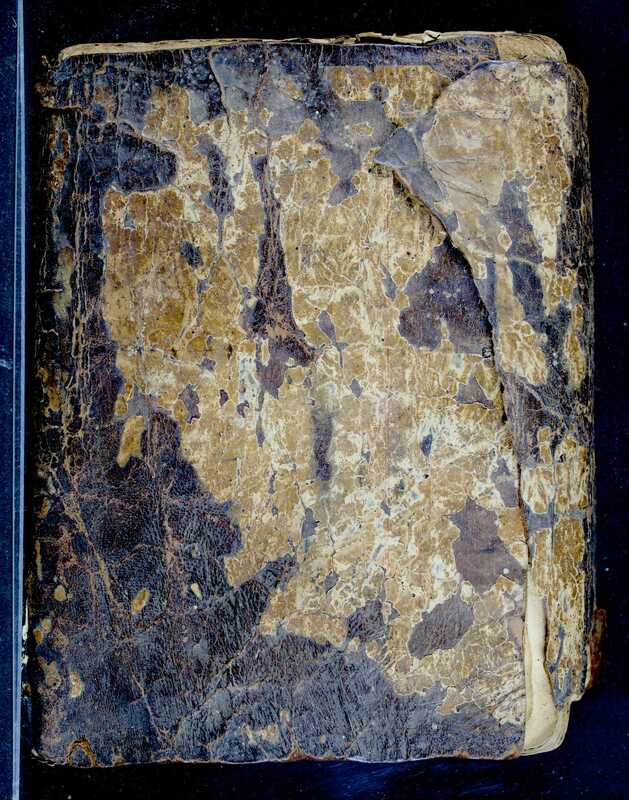
The Manuscript Bindings of Harar a priliminary examination
-
DELWANBARA
btm
You already have access to the resource. Go back to the previous page to see it.