Welcome to your new site. This is an example page.
- This is a bullet list.
- Second entry.
Back to normal again.
- This is an ordered list.
- Second entry.
Back to normal again.
This is a blockquote.
Back to normal again.
This text is bold, in a <strong> tag.
This text is italicized, in an <em> tag.
This text is underlined, in a <u> tag.
This text has a strikethrough, in a <s> tag.
This text is subscript and superscript using <sub> and <sup>, which can be used for adding notes and citations.
This is an H1 title. It is bigger than the Page Title, which is rendered in H2.
This is an H2 header, the same size as the Page Title.
This is an H3 subheader.
This is an H4 subheader.
This is an H5 subheader.
This is an H6 subheader.
This is the "Italic Title" block style.
This is the "Subtitle" block style.
This is the "Marker" inline style.
This is the "Big" inline style. This is normal text.
This text is inside a "small" inline style. This is normal text.
This is the "Computer Code" inline style.
لكن لا بد أن أوضح لك أن كل هذه الأفكار المغلوطة حول استنكار النشوة وتمجيد الألم يعرض هذا النص من اليمين إلى اليسار.
Test
-
Hyenas and Humans in the Horn of Africa
The spotted hyena (Crocuta crocuta), the most common large carnivore in the highlands and lowlands of Ethiopia, Eritrea, and Somalia, has occupied both a scavenging niche and a predatory position at the top of the food chain. My own field explorations on this animal and the observations of travelers document its long and ambivalent association with people in the Horn of Africa. Spotted hyenas in this region have mostly lived in anthropo- genic contexts rather than, as in East Africa, on wildlife. Tolerated as efficient sanitation units, hyenas have removed garbage and carrion from towns. They have also destroyed livestock, killed people, and eaten corpses. Famine, epidemics, and armed conflict have provided op- portunities for unbridled anthropophagy. The past and present coming together of human and hyena in this multiethnic region can be viewed as a vestige of a primeval African ecologi- cal relationship that dates far back in prehistory. Biological processes offer a deeper frame- work than culture with which to grasp the inherent contradiction of the hyena/human relationship past and present. Keywords: anthropophagy, Crocuta crocuta, Ethiopia, Horn of Africa, spotted hyena. -
Gold and Silver at the Crossroads in Highland Ethiopia
Using the archaeological record, European travelers' accounts, ethnographies and the authors' recent historical and ethnoarchaeological research, this article examines the production and uses of objects made from gold and silver by both elites and common folk. Drawing on evidence from both the Christian societies of the central and northern highlands with northeast Africa and the eastern Mediterranean, and the Muslim societies of the eastern highlands with the Horn of Africa and the Arabian Peninsula, the authors demonstrate how these two spheres of exchange have stood for thousands of years at a crossroads of intense cultural -
Harar, Ethiopia: A Vision And a Story from a Foreigner
Harar, Ethiopia: A Vision And a Story from a Foreigner By: Hisham Mortada In May 2008, I was in Firenze, Italy, delivering a lecture on old Muslim city to architectural students at University of Florence (Universita degli Studi di Firenze, UNIFI). After I finished speaking, I started answering questions, one of which was a turning point in my scholastic carrier. It was from a student who asked why I didn’t mention Harar when I was talking about Cairo, Damascus, Fez, Isfahan, etc. as examples of old Muslim city. I naively replied that “Harare” was not a Muslim city. The student corrected me saying, Harar, not Harare. He added, Harar was the fourth holy city for Muslims. Though that was not persuasive as I knew that time that there were only three holy cities for Muslims: Mecca, Medina, and Jerusalem, I welcomed the remark and let go. The brief discussion I had with that Italian student motivated me to search for Harar. Surprisingly, I found that Harar was on the UNESCO World Heritage List and its history goes back to the time of Prophet Mohammed, in the Seventh century AD, when some of his companions migrated to al-Habasha/Ethiopia, before Medina. That was enough to entice me to make a trip to Ethiopia early 2009 to explore Harar myself. It was my first trip ever to a non-Arab African country. After a long ride from Addis Ababa, I arrived Harar late night, yet I was eager to go around and see Jugol, the old Harar. However, it was dark, very quite and nothing to see at that late hour of the night. Next day in the morning I walked to Jugol, almost running. There, inside Jugol, nothing excited me in the beginning. Unexpectedly, the city started to grow inside me by seconds. In less than an hour, I failed in love with it. -
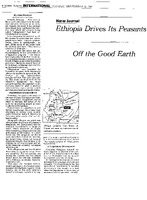
Ethiopia Drives Its Peasants
HARAR, Ethiopia - With rows of Marx and Lenin volumes in his bookcase and piles of tracts on his desk, Ali Youssef, the head of the ideology department here, explained the alacrity with which the process being called "villagization" had been accomplished in his region. In seven months, he said, half a million houses for more than two million people were built. "There is systemization; there is mobilization," he said, lifting some of the argot from his desktop literature. "They used to construct at midnight." It is precisely the speed and authoritarianism of the Government's villagization program - the relocation of peasants from their traditionally scattered homes in nearby areas to new villages established in gridlike patterns - that have caused many of its problems, Ethiopian and Western agricultural experts say. Villagization vyas heralded by President Mengistu Haile Mariam in 1984 as the answer to many of the difficulties of the impoverished, drought-stricken Ethiopian peasantry, who make up 90 percent of the country's population. By being grouped together, the argument went, peasants would be able to produce more and have easier access to such services as schools and health clinics. -
Falak Issue 2 No.1
Harari Social and political issues discussed. -
Harari Coins: A Preliminary Survey
In this survey, I will discuss the numismatic history of Harar. Up to now, coins of Harar have not been classified or studied exhaustively -
APPROACHING ETHIOPIAN HISTORY: ADDIS ABABA AND LOCAL GOVERNANCE IN HARAR , c. 1900 to 1950 Part 3
-
Abyssinian Invasion: Reminder of a Seven Century-Old Animosity
....In the south west, many Arabic inscriptions commemorating the deaths of individual Muslims from A.D. 1000 to 1267 make clear the early existence of Islam in the area between Harar and Hadiya.... -
Manufactured Tradition and The Embodiment of Place : Ethiopian Muslims in a Deterritorialized World
-
APPROACHING ETHIOPIAN HISTORY: ADDIS ABABA AND LOCAL GOVERNANCE IN HARAR , c. 1900 to 1950 Part-II
-
MUSLIM WRITERS IN AMHARIC
..Attempts made in the past to write in the vernacular languages of Ethiopiaspecifically Amharic in the Christian North and Harari in the MuslimSoutheast (5', came to nothing, the Ethiopian's innate conservatism, scribalopposition and the religious prestige of the liturgical languages, Geez forthe Christians and Arabic for the Muslims, apparently having stifled thistendency.... -
MUNZINGER'S OBSERVATIONS ON THE SUDAN , 1871
Thus Ismail's East African Empire became a reality in 1875-- a reality that was very disturbing to the major European colonial powers. However, the Khedive's leitmotiv was the control of the Blue and White Niles and their tributaries. The occupation of Keren, Harar, Aussa, Zeila and Berbera were a necessary complement to the creation of the Khedive's Central African Empire, centering on Khartoum.
btm
You already have access to the resource. Go back to the previous page to see it.