Welcome to your new site. This is an example page.
- This is a bullet list.
- Second entry.
Back to normal again.
- This is an ordered list.
- Second entry.
Back to normal again.
This is a blockquote.
Back to normal again.
This text is bold, in a <strong> tag.
This text is italicized, in an <em> tag.
This text is underlined, in a <u> tag.
This text has a strikethrough, in a <s> tag.
This text is subscript and superscript using <sub> and <sup>, which can be used for adding notes and citations.
This is an H1 title. It is bigger than the Page Title, which is rendered in H2.
This is an H2 header, the same size as the Page Title.
This is an H3 subheader.
This is an H4 subheader.
This is an H5 subheader.
This is an H6 subheader.
This is the "Italic Title" block style.
This is the "Subtitle" block style.
This is the "Marker" inline style.
This is the "Big" inline style. This is normal text.
This text is inside a "small" inline style. This is normal text.
This is the "Computer Code" inline style.
لكن لا بد أن أوضح لك أن كل هذه الأفكار المغلوطة حول استنكار النشوة وتمجيد الألم يعرض هذا النص من اليمين إلى اليسار.
Test
-
Russian & East German Documents on Ethiopia and the Horn of Africa, 1977-78
On 23 July 1977, Somalia unleashed on the African Horn an armed conflict. Under cover of the Front for the Liberation of Western Somalia (FLWS)--which had been created by the Somali leadership itself--it sent its own forces into the Ogaden, and they occupied a significant part of the Ethiopian provinces of Harar, Bale, and Sidamo, and only through the bitter fights which unfolded in October-December 1977 were they stopped at the approaches to the important centers of Harar and Dire Dawa. -
I Did Not Do It for the Money
When I have related my Peace Corps experiences to Ethiopians, they have always advised that I should write them all down and let others read. As those events are important to me and in many ways aids in my development and maturity, I had thought of writing about the Ethiopian experience and then discovered that George Schulyer had stolen the title of my intended book, "Ethiopian Stories". So, I had let these memories lay fallow for a number of years - until invited to write for an Ethiopian (Harar specifically) website. What a grand opportunity! -
Malik Ambar: A remarkable life
The African presence in the history and politics of India remains generally obscured from view. B. N. Goswamy writes about the role of an emphatic figure who played a decisive role in the history of the Deccan The emperor Jahangir shooting an arrow through the head of Malik Ambar. A 19th century version of the painting by Abu’l Hasan, dated 1616; Mughal. A little like an image embedded in a hologram, the African presence in the history and politics of India remains generally obscured from view. It is only when the parchment that is the past is taken in the hand and lightly moved, in the manner of a ‘beam of coherent light’ needed to train upon a hologram, that this presence reveals itself. Then names begin to emerge, some historical developments start to make sense, and the role of a number of emphatic figures can be seen in true perspective. Malik Ambar (1546-1626), who played such a significant role in the history of the Deccan, and became eventually such a thorn in the flesh of the Mughals, is one such emphatic figure. The entire career of this extraordinary man, his meteoric rise, appears especially startling because it seems to run against all perceived notions of the role and status of slaves. Born in the mid-sixteenth century at Harar in Ethiopia, and known simply as “Chapu”, he was sold by his poor parents to an Arab slave merchant, landed up in Baghdad, and from there, in the early 1570s, in the Deccan – known for its polyglot and tolerant culture which included many blacks or ‘Habshis’ as they were called (from the Arabic word ‘Habsh’ for Abysinnia, the older name of Ethiopia) – where he was sold again to a prominent noble at the troubled court of the Nizam Shahs of Ahmednagar. At that time, Mughal forces, fired by Akbar’s ambitious plans to bring the south also under his control, were knocking at the very portals of the Deccan, as it were. A relatively weak king on the Ahmednagar throne, bitter rivalries at the court where factionalism was rife, Abysinnians constantly flexing their muscles, an enemy at the gates: it was a nearly perfect ground in which a man like Malik Ambar – the name was given to him by a former master, and the title by a Bijapur Sultan whom he served for a short while – a powerfully built man with a brilliant mind and the abilities of a great military tactician could rise quickly to power. The Mughals did take Ahmednagar in 1600, but Ambar broke through the besieging lines and escaped with his followers eventually to control the countryside of Ahmednagar while the occupying forces held only the fort and the small area around it. This is when the lines of hostility between him and the Mughal overlords were clearly drawn. One cannot go into the life and career of Malik Ambar in any detail here, except for registering the fact that as the power of this rank outsider kept growing, that of the Mughals in and around Ahmednagar kept steadily declining. Ambar trained his followers in the art of guerilla warfare, raised a very considerable force that remained loyal to him, and remained defiant of the Mughals. Eventually, he even located a young scion of the Ahmednagar dynasty in neighbouring Bijapur, married him to his own daughter, and placed him on the throne of Ahmednagar as Sultan Murtaza Nizam Shah II, with himself as the regent of the state. Now from Peshwa, or chief counsellor, he had become regent, father-in-law, and virtual ruler of Ahmednagar. With a clear vision, he also launched great architectural projects, constructing or strengthening fortifications at vulnerable spots, building a church for Christians, raising noble monuments at Khirki which later came to be called Aurangabad, and endowing the town with a sophisticated water-supply system. The Mughals, meanwhile, chafed. Especially Jahangir (1605-1627) under whose skin Malik Ambar succeeded in getting. The emperor, it seems, was obsessed with Ambar, whose outstanding military skills he could understand but could not bring himself to acknowledge, given his own exalted position as ruler of what was then perhaps the world’s mightiest empire. In his Memoirs he referred to Ambar several times, but always in angry, almost abusive terms: “Ambar, that black wretch”, “Ambar of dark fate”, that “crafty, ill-starred one”, and so on. The two never came face to face or took the field against each other. But a painter at the Jahangiri court – the greatly gifted Abu’l Hasan – realised for his patron a triumphal dream, for he painted for him an allegory, in which the emperor is seen standing atop the globe of the world and shooting an arrow through the severed head of Malik Ambar that is impaled on a tall pike. The event never came about of course, but looking at the painting must have given the emperor great satisfaction. For woven into it are subtle references and remarkably flattering allusions. While on the hapless head of Ambar an owl sits and then falls along the pike as the arrow goes through the open mouth of the black general, a bird of paradise descends from the heavens and heads towards the emperor’s crown placed on a tall golden structure at right, as if to add its own feather to it; the globe masterfully held under his delicately shod feet by the emperor — in a clear reference to his name, Jahangir, “Seizer of the World” — rests on the back of a bull who, in turn, stands upon a large, outsized fish, allusions to ancient Hindu myths: the saving of the earth by Matsya, the universe resting upon the noble bull called Dharma; from the sky above, from behind clouds, little cherubs descend, bearing divine weapons for the emperor, as it were. Scattered over the painting, in a very minute hand, are also verses in Persian, like: “The head of the night-coloured usurper is become the house of the owl”, or “Thine enemy-smiting arrow has driven from the world (Ambar) the owl, which fled the light”. Jahangir, in this elaborate allegory, is clearly meant to be seen as symbolising the forces of goodness and light while Ambar those of darkness and evil. It is doubtful if the whole matter would have been seen like this by a Deccani painter working for Malik Ambar. But then nothing approaching this has survived from there. -
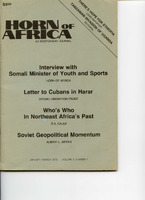
A LETTER TO CUBANS IN HARAR
The Oromo Liberation Front sent the followingletter to Cuban residents in Harar, Ethiopia lastyear. -
A Letter From Jeddah
An Interview with WSLF Spokesperson -

THE HAKAL OF HARAR SIGHTSEEING IN AN AUTO
-
The British Somaliland-Ethiopia Boundary
AN Arab sultanate with its capital at Zeila was founded by emigrants from the Yemen in, it is said, the seventh century A.D., and in the thirteenth century became powerful as the Empire of the Adals. It is interesting to note this name. Zeila is called by the Greek geographers' A8vAq1a, and Somalis to-day know it as Audal. In the sixteenth century the Arab influence was decreasing and the capital was transferred inland to Harar.... -
Cholera in Ethiopia in the 1990s: Epidemiologic patterns, clonal analysis, and antimicrobial resistance
Epidemiological data on cholera cases, occurring between 1993 and 1997 in the Harari People state, Ethiopian states of Somali, Oromiya, and Southern Peoples and in the urban administrative regions .... -
THE LEGAL ASPECT OF ETHIOPIAN-SOMALI DISPUTE
The legal aspect of the Ethiopian-Somali dispute is only a small part of a very complex human problem. When the time comes for Mogadishu and Addis Ababa to sit down for a dialogue, the juridical issues will undoubtedly hold less prominence than issues which more accurately reflect the political and economic realities of the Horn of Africa as well as the needs and aspirations of the peoples who are now caught in the middle of a savage war. However, it would be worthwhile..... -

Hyaenas Of Harar
-
Harar Citizens Sleep In Hills , Fearing Attacks
Italy Invading Harar ( World war II ) -
Prevalence and Determinants of Khat (Catha edulis) Chewing among High School Students in Eastern Ethiopia: A Cross-Sectional Study
This study was conducted to assess the prevalence and predictors of khat chewing among high school students in Harar, eastern Ethiopia.
btm
You already have access to the resource. Go back to the previous page to see it.