Welcome to your new site. This is an example page.
- This is a bullet list.
- Second entry.
Back to normal again.
- This is an ordered list.
- Second entry.
Back to normal again.
This is a blockquote.
Back to normal again.
This text is bold, in a <strong> tag.
This text is italicized, in an <em> tag.
This text is underlined, in a <u> tag.
This text has a strikethrough, in a <s> tag.
This text is subscript and superscript using <sub> and <sup>, which can be used for adding notes and citations.
This is an H1 title. It is bigger than the Page Title, which is rendered in H2.
This is an H2 header, the same size as the Page Title.
This is an H3 subheader.
This is an H4 subheader.
This is an H5 subheader.
This is an H6 subheader.
This is the "Italic Title" block style.
This is the "Subtitle" block style.
This is the "Marker" inline style.
This is the "Big" inline style. This is normal text.
This text is inside a "small" inline style. This is normal text.
This is the "Computer Code" inline style.
لكن لا بد أن أوضح لك أن كل هذه الأفكار المغلوطة حول استنكار النشوة وتمجيد الألم يعرض هذا النص من اليمين إلى اليسار.
Test
-
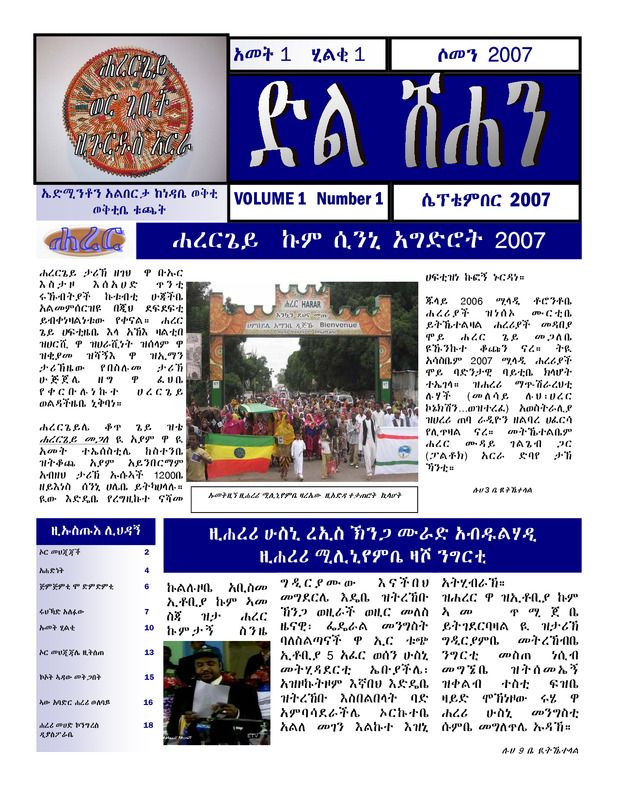
The Culub Movement I of II
The Culub movement, like any other liberationmovements was an anti-occupation, anti colonial movement.It was an uprising by the general population of Harar.Hararis never welcomed the Abyssinian forces, they bitterlyresented the illegal Occupation of foreign forces and theyorganized themselves under the banner of Culub to free thecountry and the people from the foreign power that claimssovereignty over their territory to facilitate economic andpolitical domination. The movement was widespread fromone comer to the other comer of the country. -
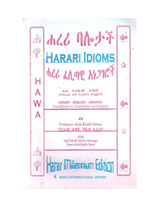
Harari Balotach ( Harari Idioms)
-
Quran-Gey
Available only Through purchase from Author or Dealers. -
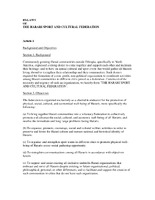
BYLAWS OF THE HARARI SPORT AND CULTURAL FEDERATION
Continuously growing Harari communities outside Ethiopia, specifically in North America, expressed a strong desire to come together and support each other and maintain their heritage; and to have an annual cultural and sport event that would gather all Hararis living abroad to strengthen their relationship and their communities. Such desires required the formation of a non- profit, non-political organization to coordinate activities among Harari communities in different cities joined as a federation. Convinced of the necessity and urgency of such an organization, we hereby form "THE HARARI SPORT AND CULTURAL FEDERATION". -
Nuria Abdullahi Jami
A committed activist for women’s rights, cultural rights and for human rights, freedom and equality; one of the first women to be elected to the Harari Regional Council, where she served for two terms; President of Harari Region for just under a month, the first (and so far only) woman to be elected President of a Region; founded the Harari Women’s Association- the first women’s association in the country; helped set up Ada’a House- a museum working to preserve and promote Harari culture -
Factors Affecting Parent-Adolescent Discussion on Reproductive Health Issues in Harar, Eastern Ethiopia: A Cross-Sectional Study
....this study was conducted to assess factors that affect parent-adolescent discussion on RH issues with their adolescents in Harar town, Harari region, Ethiopia, in May 2010 -
HARARI ACADEMIC ENDOWMENT FUND
-
Harar ( The American Cyclopaedia Volume8)
HARAR, Bum, or Adarl, a small country, with an important town of the same name, in E. Africa, lat. 9° 20′ N., Ion. 42° 17′ E., 165 m. 8. 8. W. of Zeylah on the gulf of Aden; pop. estimated at 8,000. The town is situated on a gentle slope about 5,500 ft. above the sea. On the east are cultivated fields; the W. ridge is laid out in orchards; the N. side is covered with tombs; and on the south is a low valley traversed by a mountain torrent. It is surrounded by a wall of stone and mud, about 12 ft. high and 3 ft. thick, and kept in good repair. The wall has five gates flanked by oval towers, and encloses an area about a mile long and half a mile broad. The streets are narrow winding lanes, in many places nearly choked up with rubbish. The houses are generally built of rough stone cemented with clay, and whitewashed. The emir and the principal inhabitants have houses of two stories, with flat roofs, and openings high up for windows. These houses stand at the end of large courtyards, which are entered through gates of holcus stalks. There are numerous gambita, bellshaped thatched cottages, for the poorer classes. The principal buildings are mosques, the finest being the jami, or chief mosque, which was built by Turkish architects. The town is supplied with water from numerous springs in its vicinity. The inhabitants are a distinct race, and speak a dialect which is heard nowhere else. They are rigid Mohammedans, and enforce a law which forbids a white man to enter the town. The features of the men are coarse; many squint; others are disfigured by smallpox, scrofula, and other diseases. The women are nearly as ill-looking as the men. There is a proverb current in eastern Africa, ” Hard as the heart of Harar.” High and low indulge freely in intoxicating drinks. The principal occupation of the people is tilling the soil, which for several miles around is highly cultivated, producing coffee, wheat, jowari, barley, and a variety of fruits and vegetables. The kaat, a small plant of an intoxicating quality, is very abundant. Coffee is the most important article produced, and large quantities of it are annually exported. Other exports aro slaves, ivory, tobacco, wars (safflower, or bastard saffron), tobes and woven cottons, holcus, wheat, Jcaranji (a kind of bread), ghee, honey, gums, tallow, and mules. The hand-woven tobes form an important branch of native industry, and are considered equal to the celebrated cloths of Shoa. The tobe consists of a double length of eleven cubits by two in breadth, with a border of bright scarlet, and the average value of one in the city itself is about $8. It is made of the long fine-stapled cotton which grows upon the hills, and is soft as silk, and warm enough for winter wear. The thread is spun by women with two wooden pins; the loom is worked by both sexes. The lances made in Harar are held in high estimation. Caravans arrive at all seasons. The principal are those which pass between Harar and Berbera and Zeylah, which may be considered as the porta of Harar. The March caravan is the largest, and usually consists of 2,000 camels. As of old, Harar is still the great half-way house for slaves from Zangaro, Gurague, and the Galla tribes. Harar is governed as an independent sovereignty by an emir, who rules despotically, and seeks to hide hi9 Galla extraction by claiming descent from the caliph Abubekr. The only white man known to have visited the place is the English traveller Richard F. Barton, who penetrated thither in 1855, and who described it in his ” First Footsteps in East Africa, or an Exploration of Harar ” (London, 1856). -
Women, Moral Virtue and Tchat Chewing..Gender drink and drugs
Why do so many people feel compelled to drink alcohol or take drugs? And why do so many men drink and so many women refrain? Using ideas from social anthropology, this book attempts to provide a novel answer to these questions. The introduction surveys both gender and addiction. It points out that we cannot say what men or women are really like, in any culturally innocent sense, for gender is always, even in the realm of biology, a cultural matter. The ethnographic chapters, ranging from Ancient Rome to modern Japan, similarly suggest how any substance - from alcohol to tea to heroin - inevitably takes its meaning or reality in the cultural system in which it exists.This book will be of interest to medical anthropologists, medical sociologists, anyone with an interest in the contemporary direction of anthropology as well as those working in the fields of alcohol and addiction.In page 249 of the book, Asteir and Semabtu narrate the effect of tchat among the people of Harar through the eyes of the tchat users. -
Lonely Planet Ethiopia & Eritrea
Lonely Planet, 2009 - Travel - 404 pagesExplore Ethiopia and Eritrea with the people who know it best: Lonely Planet. Discover ancient churches and cities frozen in time, trek the dramatic landscape of the Simien and Bale Mountains, and go diving in the thriving reefs of the Dahlak Islands. Explore Asmara's astounding Italian Art Deco architecture and finish the day with the perfect macchiato. Lonely Planet guides are written by experts who get to the heart of every destination they visit. This fully updated edition is packed with accurate, practical and honest advice, designed to give you the information you need to make the most of your trip. In This Guide: Tailored trips to get you up close with history and nature Take a hike or dance the day away with our festivals and activities chapter Green Index to make your travels eco friendly<p -
African textiles
Chronicle Books, 2003 - Art - 240 pagesGenerously sized and beautifully illustrated,African Textiles Is an authoritative survey of textile arts - unique and collectible rugs, tapestries, garments, and much more - from across the continent. Author John Gillow traveled extensively throughout Africa, uncovering the dazzling range of traditional hand-crafted textiles from each region. Five sections detail the textile history and traditions within Africa's major geographical areas, examining materials, dyes, decorations, patterns, and techniques. From the stripweave cloth of the Ashanti in the West to Ethiopian embroidery in the Eastsee pages 164, 167, 154 -
Arabic Literature of Africa, Volume 3 a. The Writings of the Muslim Peoples of Northeastern Africa
The present volume is fascicle A of volume III of Arabic Literature of Africa, edited by J.O. Hunwick and R.S. O'Fahey. The fascicle, compiled by O'Fahey and several collaborators, covers the Islamic writings of Northeastern Africa in Arabic and in several local languages, including Amharic, Tigrinya, Harari and Somali. Geographically, the fascicle covers the modern states of Eritrea, Ethiopia, Djibouti and Somalia. Although the Islamic literature of the region is limited, it includes an important poetic tradition in Somali and Harari and the writings of a major scholar of the colonial period in Eritrea. The volume is divided into four chapters and follows the usual ALA format. It will be followed by fascicle B, which will cover East Africa, especially Kenya and Tanzania.
btm
You already have access to the resource. Go back to the previous page to see it.