test
-
Merging Past and Present in the Museums of Harar, Ethiopia
This research involves the fields of socio-cultural anthropology, material culture studies, andmuseology, and employs a multifaceted conceptual framework to view the nature of transactionsbetween people and the objects in their environment. Specifically, this research documents the interactions among community members pertaining to the cultural objects managed by the museumsof Harar, Ethiopia. -
Muslim Commercial Towns, Villages And Markets Of Christian Ethiopia, Prior To The Rise Of Tewodros
-
Islamic Scholars Between Text And Practice,
Examines the contextualization of the Islamic faith and its practices in Harar. -

The Harar - Dire Dawa Road and "The Road Construction-Association of 1934"
-
Songs, History and Cultural Identity in the City-State of Harar, Ethiopia
The purpose of this paper is to present a historicaloutline of the secular sung repertoires composedand performed by the Ethiopian Harari, both in the city of origin and in the worldwide diaspora, underlining their elements of continuity as well as their adjustments through time and space. -
The Geography of the Ancient Walled City of Harar: Urban Structure, Cultural Heritage, and Population Diversity
From 1997 to 2003, a wide data set about the old Ethiopian city of Harar, the mostimportant historical and cultural centre of the Islamic world in the Horn of Africa, wascollected and analysed using the latest geographic information technology. Precise geotopographicaldescription of the urban elements, significant artistic and historical features,prevailing environmental conditions, and demographic and health particulars of the entireresident population were linked closely together to draw a comprehensive portrait of theancient walled city. -
Trade For Peace Not For Conflict: Harari Experience
Harar and Hararis history is much related with trade. But little is said about the fact that they have been using trade as a means of securing and maintaining peace. To preserve Harar and extend trade beyond it they made trade concessions to the Oromos and allowed the Somalis to derive income by protecting caravans that went out from and came into Harar. They allowed their currencies to circulate beyond the city-state while at the same time permitting foreign currencies to be used in the city state. Thus, trade for Hararis was not a source of conflict; rather it was a means of achieving and maintaining peace. This article suggests that underlying the idea of peaceful trade were values such as righteousness, honesty, sincerity, diligence, trust, non-discrimination and fairness in the relations among traders. Legal rules among which the sanctity of property rights and of contract were paramount functioned to protect these values" -
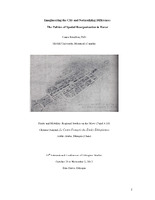
Imagineering the City and Naturalizing Difference: The Politics of Spatial Reorganization in Harar
The ways in which city form and urban planning have been recurringly used as politicalinstruments in Harar, Ethiopia, is the focus of this article in three parts. This inquiry is framed within the theoretical approach provided by anthropologist Setha LOW (1996). The empiricallyinformed arguement is that successive governments—Abyssinian, Italian, Ethiopian, and Harari—employed similar city design and planning strategies to advance particular state interestsand/or the interests of designated sets of people. -
Minelike's conquest and the local leaders in Harar
-
Infant and Young Child Feeding Practices Among Mothers Living in Harar, Ethiopia
-
The Social Dimension of Female Genital Cutting (FGC): The Case of Harari
-
HARAR, CENTRO MUSULMANO IN ETIOPIA