First and foremost we would like to express our appreciation and support for the process of social, economic and democratic developments which are being undertaken in Ethiopia. Henceforth, we honour and acknowledge the commitment of the Ethiopian government for its continuous effort to facilitate and consolidate the processes and advance peace, stability and security in Ethiopia regardless of internal and external obstacles aimed to discredit and paralyse the progress.
The objective of this joint statement is to highlight our concern to the Ethiopian people and the Ethiopian government some of the provocative comments and statements made on the debate of “Ethiopian Federalism” on Ethiopian national TV on March 3rd 2010. On the debate, we noted that a number of representatives from opposition parties indicated that the promotion of “Federalism in Ethiopia” is inherently wrong and dysfunctional highlighting the existence of the “Harari National State” as one of the anomalies of the Federalism in Ethiopian and the Ethiopian Constitution. This joint statement provides a brief response to the restatements made on the debate and provides some of the evidences that the Harari National State is indeed a model demonstrating functional Federalism in Ethiopia and Ethiopian Constitution; and a symbol of peace, tolerance and prosperity in Ethiopia.
Author: HAILEYESUS WALLE, SINTAYEHU ZEWDE & TOM HELDAL
Date: 2000
Large limestone deposits are also found in the easternpart of Ethiopia, in the Harar-Hakimgara areas. The Hakimgaralimestone has beds varying from some tens of centime
Author: A. Bosellini, a, , A. Russob and G. Assefac
Date: 2001
AbstractThe Mesozoic succession of Dire Dawa, Harar Province, Ethiopia, consists of a lower fluviatile sandstone (Adigrat Sandstone); an intermediate carbonate-marly unit, formerly called Antalo Limestone; and an upper fluviatile sandstone (Amba Aradam Formation). This study has shown that the intermediate unit consists of four different formations grouped into two depositional sequences. These sequences and their boundaries, Middle-Late Jurassic in age, are well correlated with sequences recognised throughout East Africa and a large part of Yemen. The base of the lower sequence (Antalo Supersequence) is time-transgressive (Pliensbachian to Oxfordian) and is the result of the first flooding of this sector of the Gondwana continent during the Mesozoic. The second major sequence boundary is also time-transgressive and corresponds to an abrupt deepening of East Africa and southern Arabia shallow water ramps and carbonate platforms, a collapse most probably related to the separation of Madagascar from Africa. A major tectonic event occurred in Early Cretaceous from northern Ethiopia to Yemen, and southern Ethiopia and Somalia. This vast uplift, testified by faults and angular uncomformities, was followed by deposition of fluviatile sediments over the entire region.
(P 5)
“On the other hand, Harari is the language of the urban population of the walled city of Harar in Eastern Ethiopia, that has been the major center of Islamic learning in the Horn of Africa for the last Five Centuries, the language is known in two historical stages: Old Harari in poetic and prosa texts written since the 16th century and modern Harari spoken today in Harar and by the Harari Diaspora in other Ethiopian cities and abroad…….”
Another recent project of UNESCO in Ethiopia concerns the establishment of
the Sherif Harar City Museum in Harar. UNESCO Addis Ababa was asked by
the Harari People’s National Regional State to help upgrade a private museum—
the Sherif Private Museum—into a public institution based on artifacts collected
by Mr. Abdulahi Ali Sherif since 1991 (Tarsitani & Abdulahi, 2009). His collection
includes objects related to material culture predominantly of Harari people,
but also of Amhara, Argobba, Gurage, Oromo and Somali people living in the
same region. The collection consists of numerous coins, jewelry, traditional furniture
and utensils, basketry, textiles, armaments, as well as hundreds of manuscripts,
and music recordings. Over the years, Mr. Sherif developed his own
conservation methods, particularly for metal objects, benefi ting from knowledge
transmitted by his father who was an ironsmith. The collection has continuously
been growing, thanks to personal acquisitions by Mr. Sherif and to donations
made by members of communities living in Harar. Since 1998, the residence of
Mr. Sherif served as the Sherif Private Museum, and the need to upgrade this
private museum had become acute since the place was so overcrowded with not
enough space left for display or for properly storing the collection. Since it was
a private home it was not set up to receive visitors on a regular basis. Furthermore,
there was no information material for the public, and—even worse—the
collection lacked a systematic inventory.
In order to assist in the creation of the Sherif Harar City Museum, UNESCO—
fi rst through its offi ce in Addis Ababa and later from Nairobi—managed the
project with fi nancial assistance from the Government of Norway (the Harari
cultural bureau and Mr. Sherif also received fi nancial assistance for the same
purpose from other donors, including the Embassy of France, the Embassy of the
USA, the Embassy of Sudan and private persons). The main activities of the
project are described below:
ABSTRACT On Ashura, the tenth day of the Islamic month of Muharram, Hararis celebrateWirshato, a gourd-smashing ceremony that commemorates the prohibition of alcohol indicatedby the Prophet Muhammad. During the ceremony, young boys run around the city holdingsticks and singing the Wirshato song; when they enter the house compounds, they are giventraditional gourds, habitually employed to contain liquids. The boys hence smash the gourdwith their sticks and make toys out of the broken pieces, to symbolize the benefi ts that deriveby breaking bad habits. Other members of the community take part in the festivities by donatinggourds and by feasting on porridge to usher in abundance for the coming year. This briefpaper will show how the activities surrounding the Wirshato ceremony in Harar are concernedwith the concept of renewal and are derived from Islamic and customary sources.
A survey on camel meat productivity and consumption was conducted in Jijiga and Harar towns in 1999. Almost all the camels slaughtered were adults, predominantly males. Measurements of height, hump girth and thoracic girth were used to estimate the live weight. All the measurements were significantly greater in the male than in the female camels. Average live and carcass weights were 400 and 211 kg, respectively. Males were significantly heavier (p < 0.05) and had better dressing percentages than females. The carcasses contained averages of 76% meat, 12% fat and 20% bone for both males and females. The difference between the males and females was not significant for the ratio of meat and bones, except for fat, which was higher in the males. Camel meat is regarded as a high-quality food with medicinal value and as a least-cost source of meat. Camel meat is preferred to that of any other livestock by some people, particularly by the Somalis in Jijiga town. It is also more available, especially during the dry season when beef is in short supply. Hence, camel meat is a socially acceptable, economically viable and environmentally adaptable alternative source of meat, consumption of which should be encouraged.
These defense forces were very important for the Ottomans for protectionof Africa's Eastern coasts. Because if Portugese rule contained Arab peninsulaand Red Sea it would be very difficult fort he Ottomans to be dominantpower in the region for long time. It is for this reason that the Ottomansfelt the need to strengthen the Mamluki defense forces immediately. With the help of this forces that the Ottomans had the opportunity to helpSultanate of Harar in today’s Etiopia. By means of this valuable assistanceSultanate of Harar won victories against Christian kingdom that was receivinghelp from Portugal.
"As far as it can hitherto be stated the Harla were the oldest identifiable population in the Harar Plateau. Between the 14th and 16th centuries they possessed the highly developed peasant civilization with urban center and stone architecture. When Abadir (Umar, Al, Rida), the legendary ancestor of Harari, reached Harar in the early 13th century, he was acknowledged by the Harla, the Gaturi and the Argobba"
"Action Research to save some endangered pearls of Eastern Ethiopia offeringa developed and complete tourism route as an economic alternative to theirrapid and irreversible destruction. Reports from two missions in early 2008.Dedicated to the Presidents of the Regional States of Oromia and Harari.
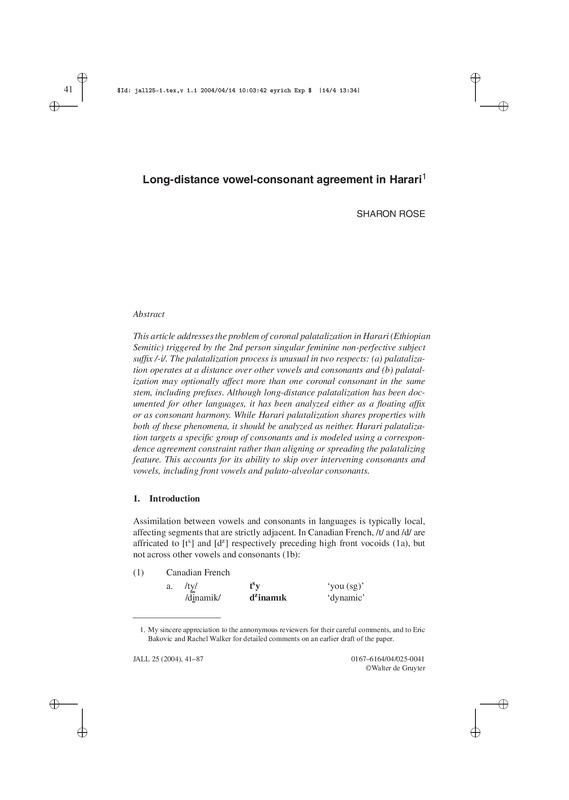
This article addresses the problem of coronal palatalization in Harari (Ethiopian Semitic) triggered by the 2nd person singular feminine non-perfective subject suffix /-i/. The palatalization process is unusual in two respects: (a) palatalization operates at a distance over other vowels and consonants and (b) palatalization may optionally affect more than one coronal consonant in the same stem, including prefixes. Although long-distance palatalization has been documented for other languages, it has been analyzed either as a floating affix or as consonant harmony. While Harari palatalization shares properties with both of these phenomena, it should be analyzed as neither. Harari palatalization targets a specific group of consonants and is modeled using a correspondence agreement constraint rather than aligning or spreading the palatalizing feature. This accounts for its ability to skip over intervening consonants and vowels, including front vowels and palato-alveolar consonants.
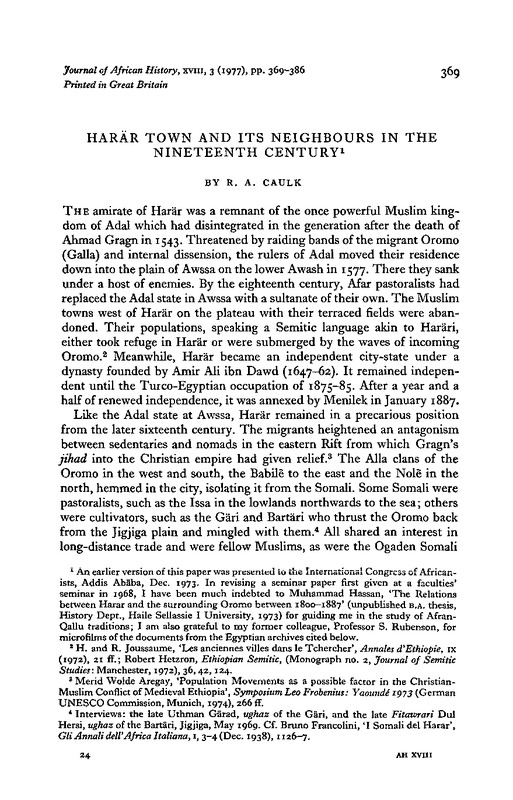
The survival of the Semitic-speaking, Muslim townsmen of Harär in the midst of animist Oromo who migrated into the eastern highlands of modern Ethiopia in the late sixteenth century and settled as pastoralists is something of an anomaly, at least in the eastern Rift. Other pre-migration settlements of Muslim farmer-traders, presumably also speaking a southern Semitic language, appear to have been submerged and displaced. The Haräri’s good fortune is not to be explained by their use of firearms and simple fortifications. Economic interdependence, the awe the newcomers felt for the town’s saints and the greater cohesion of the townspeople probably played a greater role than mere self-defence.
A balance of power was needed, however, if the town was not to be swamped. This equilibrium seems to have been upset at the very time that the trade of the Red Sea and Gulf of Aden was revived by Egypt in the second quarter of the nineteenth century. Neither the succession to the amirate of pacifist princes nor the betrayal of the town to outsiders by the half-Oromo ruler, Amir Muhammad ibn Ali (1856–75), can correctly be blamed for this reverse although these are the excuses given in Haräri tradition. Rather, the repeated appeal to sections of the Oromo by factions within the town in struggles for the throne from the 1820s led to the Haräri becoming clients to neighbours who were still overwhelmingly animist herders little concerned with the commerce on which the townsmen’s prosperity depended and little attracted to the titles and Muslim insignia with which the amirs rewarded those of the cultivating Oromo minority who paid taxes and rents in grain and supplied the town with other foodstuffs and its market with crops for …
Though denigrated in the town’s traditions, Amir Muhammad ibn Ali began the systematic proselytization of the surrounding Oromo and sought to induce more of them to cultivate crops for sale. Conversion and farming for the town’s market, along with the appointment from the town of officials to replace the Oromo’s elected officers, were the means by which, during the Turco-Egyptian occupation (1875–85), rulers with greater military resources obliged the confederation of the four great Oromo clans around the town (the Afran-Qallu) to adopt a way of life more in harmony with the interests of the townsmen. Despite the conquest of Harär and the surrounding Oromo and Somali by non-urban, Christian Ethiopians in the brief reign of Muhammad Ali’s son, Amir Abdallahi (1885–7), the Islamic and mercantile legacy of the town was deeply enough rooted by then to flourish among the Afran-Qallu and to distinguish them, like the Haräri themselves, from their conquerors.
Footnotes
1 An earlier version of this paper was presented to the International Congress of Africanists, Addis Abäba, Dec. 1973. In revising a seminar paper first given at a faculties’ seminar in 1968, I have been much indebted to Muhammad Hassan, ‘The Relations between Harar and the surrounding Oromo between 1800–1887’ (unpublished B.A. thesis, History Dept., Haile Sellassie I University, 1973) for guiding me in the study of Afran-Qallu traditions; I am also grateful to my former colleague, Professor S. Rubenson, for microfilms of the documents from the Egyptian archives cited below.
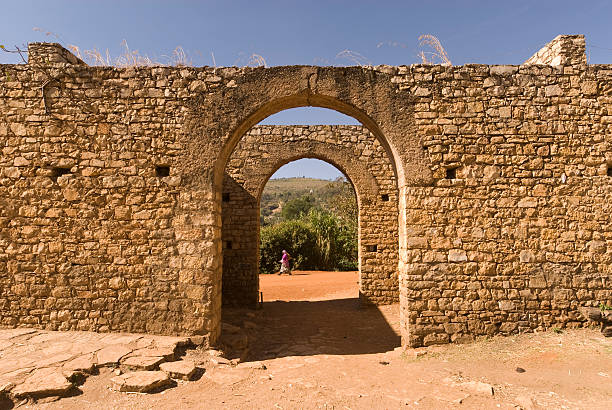
In my last post I wrote about how Harar is an alluring walled city that made me throw away my travel plans and stay for three weeks. A serene atmosphere and an ever-widening circle of knowledgeable, hospitable acquaintances were what kept me there, but what is there to actually see? Plenty. The main attraction, of course, is the city itself, with its crowded markets, quiet back alleys, and mixture of Ethiopian, Egyptian, Arab, and Italian architecture. A long wander in the Jegol, as locals call the old city, will give you a feel for life in this unique place. Don't worry about getting lost. While the winding little alleyways make it inevitable, the city is so small you won't stay lost for long. Walking at night is safe and very romantic with the right company and a full moon.
Ethnicity and federalism is briefly discussed. TheHarari state formation and the Historical andcultural reasoning enlight of the present day federal republic of ethiopia is given focus. Please go to page 230 to read about Harari State.
Describes the houses in the town of Harar Ethiopia. Plans and photographs illustrate the evolution of the arrangement of the city, flourishing from the 17th century until the end of the 19th century. Born in the 8th century, it is the great fourth Holy City of Islam and is experiencing a specific urban culture.
A cross-sectional study was conducted to estimate HIV seroprevalence among infectious (smear positive) cases of pulmonary tuberculosis and to describe the relation between antituberculosis drug resistance and infection with human immunodeficiency virus. A total of 418 smear positive pulmonary tuberculosis patients who attended the out patient departments of Harar Tuberculosis Centre and two general hospitals were studied from October 1994 through January 1995. The majority (94%) of these patients were from the tuberculosis centre. Sputum cultures were positive for 338/418 (80.9%) patients. HIV seroprevalence was 92/418 (22.0%) among smear positive and 69/338 (20.4%) among culture positive patients. HIV positive patients were more likely to be from urban than rural areas (p < 0.001). Initial resistance was not affected by HIV seropositivity. Secondary drug resistance was significantly higher in HIV positive patients than HIV negatives (p < 0.05). Although not significant, HIV positive patients were more defaulters than HIV negatives. Significantly higher numbers of HIV positive pulmonary tuberculosis patients were cases of relapse and treatment failure (p < 0.05). Other studies are required in order to assess the impact of HIV infection on the spread of anti-tuberculosis resistance. Supervised and appropriate treatments with follow up are required in order to minimise the spread of drug resistant tubercle bacilli among HIV infected patients
African Study Monographs, Suppl.41: 5-18, March 2010 5INTEGRATING LOCAL KNOWLEDGE IN ETHIOPIANARCHIVES:MUSIC AND MANUSCRIPTS IN THE COLLECTIONOF ABDULAHI ALI SHERIFBelle Asante TARSITANIGraduate School of Asian and African Area Studies, Kyoto UniversitySimone TARSITANIDepartment of Music, The Open University, UKABSTRACT Since the early 1990s, important examples of Harari tangible and oral culturalheritage were preserved in the private home museum of Abdulahi Ali Sherif in Harar, Ethiopia.The volume and quality of audio recordings of musical and ritual practices, along with themanuscripts from this collection indicate how a resourceful individual, when supported by acommunity of local patrons, can be instrumental in conserving heritage in a local archive, evenin the absence of major funding sources. This case study presents a review of Mr. Sherif’smuseum collection and explores pertinent challenges in conservation and curatorship of theprivate holdings. Having followed the transformation of the collection to a public-privatepartnership,the authors consider the wider implications of collaborations in the managementof archives in regional museums in Ethiopia. This research employs examples of various formsof documentation used in the analysis of local Islamic ritual practices to show that local actorsare integral to the sustainable management of archives. The collaborations involving thecollectionof music and manuscripts in the Sherif collection are presented as exemplary of howa community-run museum project can be a particularly appropriate and accessible venue toengage audiences in the legacies found in archives.
Contribute
Login or click your token link to add a new record.