A serially numbered list is given of plant species, both cultivated and wild, with the insect species found associated with each in Harar Province, Ethiopia, during 1960 & 64. In a second list, the insect species are arranged under orders and, alphabetically, under families and genera, the plant species with which they were associated being indicated by numbers referring to the first list.
Abstract Comparison of the social and political structure in two Muslim urban societies in East Africa - Harar in eastern Ethiopia and Lamu on the northern Kenyan coast - from the 18th to the early 20th century. In Lamu, as in other coastal Swahili societies, political authority was supposed to be vested with representatives of the leading families who claimed long-standing local residence and financial integrity. However, rulers were hardly ever able to develop absolute power; more often their rule was of the primus inter pares type. The political structure in Harar was hierarchical with a secular ruler, surrounded by a number of appointed officials, exercising absolute power. As in Lamu, social control within the Harari community appears to have been more democratic. Women in Lamu were considered socially, intellectually, and morally inferior. They were not supposed to have any part in public affairs. Despite the custom of infibulation and clitoridectomy, the status of women in Harar was far more independent; they had an equal share in the social and religious life of the city. (Source: ASC Documentation).
2000 MOSLEMS KILLED. LONDON, April 8. The Governor of Harar killed 2000 Moslems at Jigjiga, on the Abyssinian frontier. King Menelik sends him 8000 horsemen
AN ATTACK. Aden, January 24 News has been received from Somauli that the Abyssinian forces attacked and completely routed the Ameer of Harar's troops. They then occupied the town of Harar. The Ameer, however, escaped.
‘I left my life behind to catch a glimpse of life’ Arthur Rimbaud
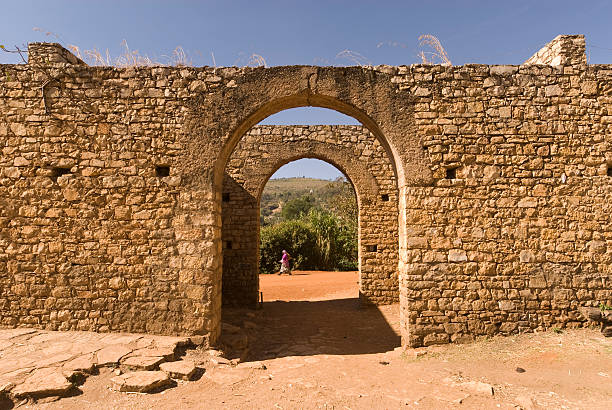
The road to Harar is green, along the way there are lush fields, terraced farms on slopes, high growing shrubs; the road winds upwards and it winds downwards. Children dance in its middle, they paint the white line that is not there, they own it, it is their road, they wave at the car as we weave around them. “Faranji, faranji,” they call, “you want, you want …, faranji, ten birr, ten birr …yooo, yooo yooo.” They wave branches of green leaves, they sell khat, the biggest cash crop that grows in the region, fresh, delirious. My excitement grows as we move up the slopes of the mountains, organic gold, I am going to the city of a poet, the city of an outcast who gave up poetry and turned to guns, the city of Rimbaud.
First and foremost we would like to express our appreciation and support for the process of social, economic and democratic developments which are being undertaken in Ethiopia. Henceforth, we honour and acknowledge the commitment of the Ethiopian government for its continuous effort to facilitate and consolidate the processes and advance peace, stability and security in Ethiopia regardless of internal and external obstacles aimed to discredit and paralyse the progress.
The objective of this joint statement is to highlight our concern to the Ethiopian people and the Ethiopian government some of the provocative comments and statements made on the debate of “Ethiopian Federalism” on Ethiopian national TV on March 3rd 2010. On the debate, we noted that a number of representatives from opposition parties indicated that the promotion of “Federalism in Ethiopia” is inherently wrong and dysfunctional highlighting the existence of the “Harari National State” as one of the anomalies of the Federalism in Ethiopian and the Ethiopian Constitution. This joint statement provides a brief response to the restatements made on the debate and provides some of the evidences that the Harari National State is indeed a model demonstrating functional Federalism in Ethiopia and Ethiopian Constitution; and a symbol of peace, tolerance and prosperity in Ethiopia.
Author: Ayalu A Reda1*, Asmamaw Moges1, Berhanu Yazew2 ...
Date: 2010
Health To assess the prevalence of cigarette use and its determinant factors among high school students in eastern Ethiopia. A cross-sectional study was conducted using structured self-administered questionnaires among 1,721 school adolescents in Harar town, eastern Ethiopia. Univariate and multivariate logistic regression analyses were performed to examine associations.
The survival of the city-state of Harar remains one of the 'mysteries of history of the region'.1 Harar, once a pivotal point for political dominance of the Horn of Africa, collapsed like a house of cards after the defeat of Gragn in the sixteenth century.2 But it survived as a trading and religious centre up to the region's incorporation into the Ethiopian empire in 1887. Immediately after the wars of Ahmad Gragn,
Contribute
Login or click your token link to add a new record.